
Why Is Synchronization Critical in a Tandem Press Brake?
A CNC Tandem Press Brake combines two press brakes to process extra-long workpieces as one synchronized bending system.
However, simply placing two machines side by side is not enough.
During a long bending operation, both rams must move together with extremely small positional differences. If one machine moves faster, slower, or reaches the bending position at a different time, the workpiece can experience uneven bending angles, twisting, or dimensional errors.
This is why multi-axis synchronization is one of the most important technologies in a tandem press brake.
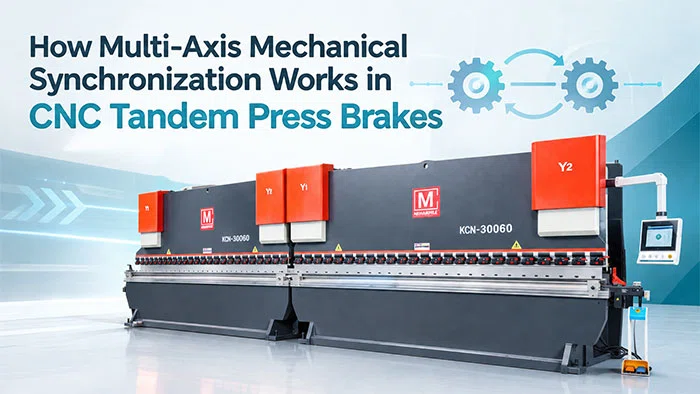
What Are Y1, Y2, Y3 and Y4 Axes?
A conventional CNC press brake normally uses two main bending axes:
- Y1: left-side ram movement
- Y2: right-side ram movement
In a tandem configuration, two machines work together, so the CNC system must coordinate the corresponding axes across both machines.
Depending on the machine architecture, these can be represented as Y1/Y2/Y3/Y4 or as coordinated axis groups.
The objective is simple:
Keep both press brake rams moving together and maintain the correct relationship between the upper tool and lower dies across the entire tandem length.
This becomes particularly important when bending long plates where even a small synchronization error can affect the final part.
How Does Multi-Axis Synchronization Work?
The synchronization process can be understood as a continuous Command → Move → Measure → Compare → Correct cycle.
1. CNC Sends the Motion Command
The operator enters the bending parameters, including bending angle, stroke position, speed, and bending sequence.
The CNC controller calculates the required movements and sends coordinated commands to the bending axes.
In a tandem configuration, both machines must follow the same bending sequence.
2. Hydraulic System Drives the Rams
The CNC signals the electro-hydraulic proportional or servo valves.
These valves regulate hydraulic oil flow to the cylinders, controlling how quickly each side of the ram moves.
The two machines therefore do not simply “move together”; their movement is actively controlled.
3. Linear Scales Measure Actual Position
Position feedback is essential.
Linear scales installed on the machines continuously measure the actual position of the ram. The feedback is sent to the CNC controller, allowing the system to know whether each axis is following its programmed position.
This creates a closed-loop control system rather than relying only on the commanded movement.
4. CNC Compares the Axis Positions
The controller compares the programmed position with the actual position of each axis.
For example, if one side of a ram is slightly ahead of another, the CNC can identify the position difference and calculate a correction.
This continuous feedback is what helps maintain synchronization during the bending stroke.
5. The System Makes Real-Time Corrections
Once a deviation is detected, the CNC adjusts the corresponding valve signal.
The hydraulic system can then increase or reduce the oil flow to the relevant cylinder.
The process repeats continuously throughout the bending cycle:
Position command → Ram movement → Position feedback → Error calculation → Correction
This closed-loop process allows the tandem system to maintain coordinated ram movement instead of relying on mechanical alignment alone.
How Does Synchronization Improve Long-Part Bending?
The main benefit is consistent bending across the entire workpiece.
Consider a 10-meter-long sheet being bent simultaneously by two connected press brakes.
If the left machine reaches the target position before the right machine, the ram can become temporarily misaligned. That difference can affect the bending angle and create dimensional variation.
Multi-axis synchronization helps both machines behave as a coordinated system.
The result can include:
- More consistent bending angles
- Better dimensional accuracy
- Reduced twisting
- More stable long-part production
- Less manual correction
- Improved repeatability
Synchronization and Deflection Compensation
Synchronization alone does not eliminate every source of bending error.
When a long workpiece is bent under high tonnage, the machine frame and bed can experience elastic deflection. This can cause the center of the workpiece to bend differently from the areas near the cylinders.
Therefore, a high-performance tandem system may also use mechanical or CNC-controlled crowning/deflection compensation.
The CNC system can coordinate compensation across the two machines so that the bending result remains more consistent along the combined working length.
This is particularly important for long and heavy workpieces.
What Makes a Reliable Tandem Synchronization System?
When evaluating a CNC Tandem Press Brake, look beyond the total bending length and tonnage.
Pay attention to:
Closed-loop position feedback
Linear scales provide the CNC with actual ram-position information.
Multi-axis CNC control
The controller should be capable of coordinating the bending axes of both machines.
High-response hydraulic control
Proportional or servo valves need to respond accurately to CNC correction signals.
Mechanical alignment
The two press brakes must be properly aligned and installed as a combined system.
Deflection compensation
Crowning helps compensate for deformation under high bending loads.
Synchronized back gauge
The back gauge system must also maintain accurate positioning across the tandem working area.
Why Multi-Axis Synchronization Matters
A tandem press brake is more than two press brakes working next to each other.
Its real capability comes from the coordination between CNC control, hydraulic systems, position feedback, mechanical alignment, and compensation technology.
By continuously monitoring and correcting multiple bending axes, the system allows two machines to operate as one coordinated bending solution for extra-long workpieces.
For applications such as steel structures, transportation equipment, shipbuilding, construction components, light poles, and large fabricated parts, reliable synchronization is essential for maintaining bending quality across the entire workpiece.
If you are selecting a Tandem Press Brake, evaluate not only tonnage and working length, but also the machine’s synchronization architecture, feedback system, CNC control, hydraulic response, and deflection compensation.
Explore MIHARMLE Tandem Press Brake Solutions → Get a Quote
Recommended reading:
Tandem Press Brake Assembly & Crowning Calibration Guide