Introduction
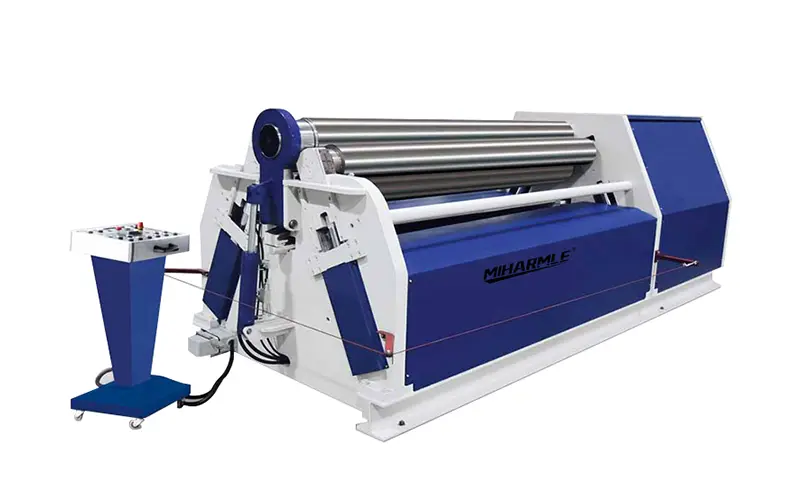
With the advancement of technology, various sheet metal fabrication manufacturers are now shifting from 3-roll plate rolling machines to advanced 4-roll plate rolls.
Precisely, a 4-roll plate roll features four rollers, which enable continuous pinching, pre-bending, and rolling in a single setup. The top and bottom roll clamp the metal sheet, and the side rolls shape the metal. This enhances the accuracy of machines in producing cylindrical or conical shapes for various applications.
Beyond accuracy, 4-roll sheet rolling machines offer numerous additional benefits. This article outlines several advantages you may want to be aware of. So, let’s get into the details and explore more about them.
Accessories
Add-ons expand machine capabilities. A 4‑roll plate roll can accommodate various accessories that boost the workflow and capabilities. Some of the major accessories include:
- Hardened and ground rolls for wear resistance,
- Infeed conveyors for faster staging,
- Overhead or side supports for handling large diameters.
- The hydraulic drop ends safely and quickly removes large finished shells. ,
- NC/CNC controls reduce setup time and improve repeatability.
Smart accessories also enhance ergonomics, reducing reliance on cranes and enabling safer one-person operation. The result is a machine that grows with production needs, from short runs to high‑volume, multi‑shift work.
Precision and Accuracy
As discussed earlier, the fourth roller in the 4-roll plate rolling machines serves to improve the accuracy and precision. It clamps the metal sheet, preventing it from slipping or sliding during the bending operation. From initial feeding to pinching and finally calibration, the sheet metal goes through a continuous bending cycle. It improves tracking and keeps the bend line exactly where it’s programmed.
Independent side-roll axes enable fine control of the radius. Therefore, the operator can make small corrections without losing alignment. With CNC integration, all information, such as roll positioning and sequencing, can be tracked. It gives precise control over the bending cycle.
As a result, the final cylindrical shells have tighter tolerances. Additionally, less reworking is required, especially for stainless and high-strength steels. As with these metals, springback can be unpredictable.
Conical Rolling
Four‑roll machines handle cones more efficiently. As the material remains clamped, one side roll is offset and tilted to generate the taper. Guided asymmetry and programmable side-roll paths enable operators to form shallow cones or steep frustums with consistent small-end diameters. A cone shoe (snubber) then swings into place at the end of the top roll to support the large diameter. It holds alignment well and keeps the work steady as the taper closes. With proper tooling and support arms, seams align more reliably. It is valuable for pressure‑bearing cones and transitions in ductwork, hoppers, and process equipment. CNC integration for cone segments also simplifies repeat orders and minimizes scrap.
Construction
These plate rolling machines are designed for demanding tasks. Therefore, their construction involves high-strength hardened components. They help resist heavy loads, delivering smooth, high-force motion. Some of the components are:
- Sturdy frame
- Large‑diameter rolls,
- Induction-hardened surfaces
- Spherical roller bearings
- Hydraulic actuation
- planetary or torque‑shaft systems
- Linear or arc‑guided side rolls
All these parts maintain alignment and longevity. They synchronize roll movements under heavy bending moments, improving pre‑bend quality and roundness. Reliable manufacturers use industry-recognized parts that are readily available in worldwide markets. So, you don’t have to wait for factory-specific replacements.
Ease of Operation
A four‑roll is simple to run because the plate stays clamped from start to finish. That steady pinch means no flipping, less re‑feeding, and fewer setup checks. The sequence is clear. Loading pinching, pre‑bending one edge, index, pre-bending the other, and then rolling to size. The entire process often proceeds smoothly in one seamless pass. Touchscreen controls guide each step and store proven trackdowns for common grades and thicknesses. Springback presets help hit the radius faster with fewer trials. Clear sightlines and programmable supports reduce the need for multiple helpers. For many shops, the four‑roll platform reduces operator skill dependency. Additionally, it shortens the training curve without sacrificing quality.
Guiding Options
Guiding systems help stabilize and steer plates during the forming process. Most pyramid‑style rolls move the two side rolls toward a fixed top roll, but how they move matters from job to job. Two types of guides drive them:
- Planetary guides swing the side rolls along an arc. It follows the natural bend path. Also, it helps reduce springback from light gauges to mid‑thickness plates. This curved motion also facilitates achieving tight pre-bends and small diameters. That’s why smaller four-roll machines often use planetary systems.
- Rectilinear guides direct the side rolls along straight and diagonal paths toward the top roll. It shortens the distance between bending points and stiffens the setup. That extra stiffness delivers several benefits. It provides more force for heavy pre‑bends, better control on high‑strength steels, and cleaner calibration on thick shells.
High-end manufacturers provide both types of guides. While some of them can be customized according to your business requirements. So you must choose carefully and understand their benefits for high productivity.
Material Loading
In 4-roll plate rolls, sheets can be fed horizontally from both sides. Therefore, horizontal loading is a significant advantage on four-roll machines. Plates stage on infeed tables, square against stops, and feed straight into the pinch. This cuts crane picks and improves safety with wide or heavy stock. Powered conveyors and squaring arms enable one operator to position large sheets without strain. Quick-adjust stops and laser guides expedite changeovers in high-mix work. Smooth transfer from table to pinch protects edges and finishes, which is particularly important for stainless steel and coated plates.
On many 3-roll setups, operators flip or re-feed to pre-bend both ends, which adds handling, time, and risk. Four roller machines keep the sheet clamped, allowing both ends to be pre-bent and rolled in one setup with reduced crane usage. The result is faster loading, fewer touches, and cleaner surfaces.
Pre-bending
Pre-bending is quick and steady on a four-roll machine because the sheet stays clamped. While the side rolls form a tight edge radius, which cuts the flat at both ends, and sets a clean start for rolling. With both ends handled in one setup, there’s no need to flip. So handling drops and throughput rises, and the cylinder closes with less mismatch for easier seam fit‑up. Tighter ends also result in smaller weld gaps and less filler material. This saves time and heat input while protecting the finish.
Productivity
The single-setup flow offers a speed advantage. Loading, pre-bending both edges, and rolling to size in one rhythm trims the cycle time. It often delivers a one‑pass finish within capacity. Staged plates on infeed tables, programmable supports, and stored CNC sequences ensure continuous motion. While the following job lines up, so less time is lost between parts. Fewer touches also ease bottlenecks before welding. So, shifts end with more shells completed and schedules that hold.
Safety
Keeping the sheet pinched throughout forming limits slips and sudden moves, so the risk drops when working with heavy plate. Horizontal loading reduces awkward crane swings and improves posture. While interlocks, light curtains, mats, and e‑stops add layers of protection. Clear prompts on the HMI guide each step, so fewer re‑grips and fewer rushed corrections make the process calmer and safer.
Versatility
A four‑roll handles cylinders, cones, and multi‑radius shells, then finishes with calibration passes, all scaled by model and roll diameter. With the right roll hardness and surface preparation, it works on carbon steel, stainless steel, aluminum, and abrasion-resistant grades without scarring. Tooling and supports are adapted to long shells for tanks, pressure vessels, ducts, and towers, while CNC recipes enable step-rolling and repeat parts with minimal trial work.
Z‑Axis Motion
The Z-axis supports tracking the part’s height as the diameter closes, so the shell stays aligned with the tooling and sag is held in check. On cones, coordinated Z‑axis moves stabilize both the small and large ends while the taper forms, which protects geometry as the load shifts. When Z‑axis motion syncs with roll positions, ovality drops, and surface marks and edge peening are less likely.
Conclusion
As you have read the article, it is now clear that 4-roll plate rolls are versatile. Compared to 3-roll plate rolling machines, they offer multiple benefits in a single setup. So, their necessity increases from small metalworking shops to large facilities. With advanced CNC integration and touchscreens, they are now very easy to operate. When choosing these machines to elevate your growing needs, understanding these advantages will help you. For a perfect selection, contact a reliable manufacturer to assist you in the selection process.