
Why Heavy-Duty Fabrication Requires a Different Bending Solution
European infrastructure and renewable-energy projects increasingly involve large steel components that place demanding requirements on fabrication equipment.
Long workpieces, high-strength structural steels, heavy plate, strict dimensional tolerances, and large bending forces can exceed the practical working range of a conventional single press brake.
This is where a Tandem Press Brake becomes valuable.
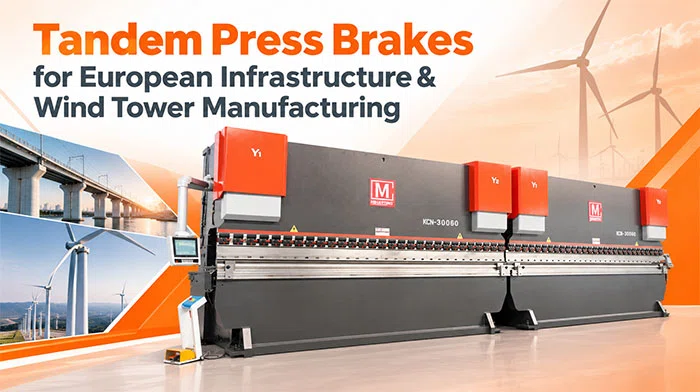
By combining two CNC press brakes into one synchronized bending system, manufacturers can process extra-long components while maintaining coordinated ram movement across the working length.
For European steel fabricators, this makes tandem bending particularly relevant to infrastructure, transportation, energy equipment, structural steel, and wind-energy component manufacturing.
What Is a Heavy-Duty Tandem Press Brake?
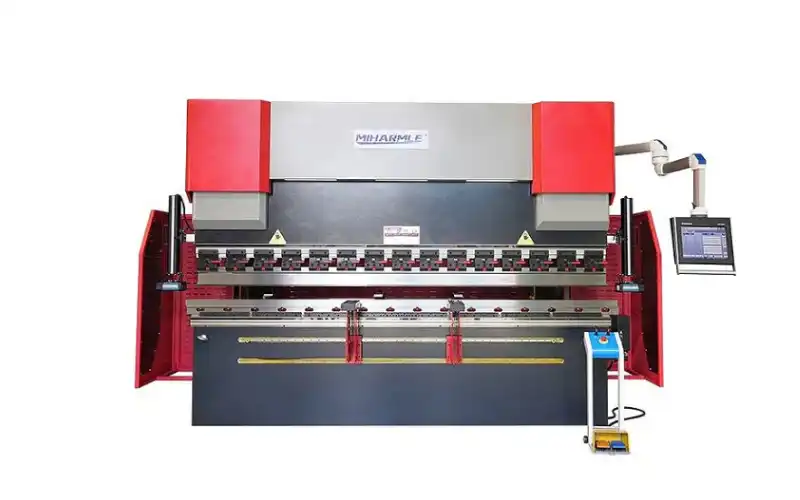
A Tandem Press Brake consists of two press brakes installed and controlled to operate together.
Instead of treating them as two independent machines, the CNC system coordinates their bending movements.
A typical system combines:
Press Brake A + Press Brake B → One Extended Bending System
Depending on the configuration, the machines can provide increased:
- Working length
- Bending capacity
- Multi-axis control
- Long-workpiece support
- Production flexibility
This architecture is especially useful when a component is too long to be processed efficiently on a conventional press brake.
Why Long Steel Components Are Challenging to Bend
Increasing bending length creates more than a simple size problem.
When a long, heavy workpiece is placed across two machines, small differences in ram position can affect the bending result.
Manufacturers need to control:
Synchronization — Both machines must follow the programmed bending movement.
Deflection — Heavy bending loads can cause elastic deformation of the machine and tooling.
Positioning — Long workpieces must remain accurately positioned throughout the operation.
Material variation — High-strength steels can behave differently according to thickness, tensile strength, and rolling direction.
Handling — Large parts can be difficult and unsafe for operators to manipulate manually.
A properly configured Tandem Press Brake addresses these challenges through CNC synchronization, position feedback, suitable tooling, crowning, and workpiece-support solutions.
Tandem Press Brakes in European Infrastructure Manufacturing
European infrastructure fabrication covers a broad range of heavy steel products.
Typical tandem bending applications can include components for:
- Bridges and structural steel projects
- Railway and transportation infrastructure
- Large industrial buildings
- Energy facilities
- Utility structures
- Heavy equipment
- Long beams and profiles
- Large fabricated enclosures
These applications often require manufacturers to bend components that are both long and heavy.
Instead of investing in one extremely large custom press brake, a tandem configuration can provide another approach to achieving the required working length and bending force.
An additional advantage is flexibility: depending on the machine design and control architecture, tandem systems may also allow the machines to perform suitable jobs independently when synchronized operation is not required.
Tandem Press Brakes in Wind Energy Manufacturing
Wind-energy manufacturing is an important heavy-fabrication market in Europe.
Modern wind towers consume substantial quantities of structural steel. For example, approximately 25,000 metric tons of heavy plate were supplied for 36 towers at Denmark’s Thor offshore wind farm. European wind-tower manufacturing capacity is also expanding, including new production investment in Poland serving Polish and German markets.
For fabricators, this creates demand for productive and reliable heavy-plate processing equipment.
However, it is important to distinguish between different forming processes.
Wind Tower Shells
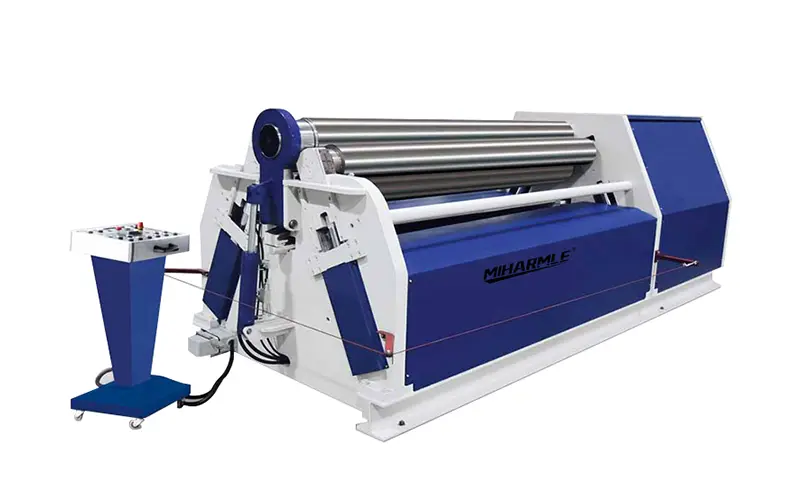
The cylindrical or conical shell sections of a conventional steel wind tower are normally produced using heavy-duty plate rolling machines.
Large steel plates are cut, edge-prepared, rolled into cylindrical or conical sections, and then welded.
A Tandem Press Brake should therefore not be presented as the primary machine for rolling complete wind-tower shells.
Where Tandem Bending Can Add Value
Within wind-energy and related heavy-fabrication operations, Tandem Press Brakes can be used for suitable long components such as:
- Long structural reinforcement parts
- Door-frame components
- Internal support structures
- Equipment mounting components
- Long channels and profiles
- Heavy brackets
- Structural transition components
- Auxiliary steel fabrications
The exact application depends on part geometry, material, thickness, bending radius, and required working length.
How CNC Synchronization Improves Long-Part Bending
Synchronization is at the heart of a CNC Tandem Press Brake.
During bending, the controller coordinates the movement of the two machines while position-feedback devices monitor actual ram positions.
The process can be simplified as:
CNC Command → Ram Movement → Position Feedback → Error Comparison → Real-Time Correction
This closed-loop approach helps maintain coordinated movement across the combined working length.
High-end CNC platforms can also provide advanced programming and compensation functions. For example, Delem’s DA-69T supports 2D/3D programming, automatic bend-sequence calculation, collision detection, sensor-bending interfaces, frame-deflection compensation, and TandemLink capability.
Heavy Plate Bending Requires More Than High Tonnage
A common purchasing mistake is to select a Tandem Press Brake based only on tonnage.
For heavy-duty infrastructure applications, manufacturers should evaluate the complete bending system.
1. Working Length
The machine must accommodate the longest expected component while providing appropriate support and tooling.
2. Bending Force
Required tonnage depends on material tensile strength, thickness, bending length, V-die opening, and bending method.
3. Frame Rigidity
Heavy loads require a machine structure capable of maintaining stability during repeated production.
4. Multi-Axis Synchronization
Reliable CNC control and position feedback are essential when two machines perform one bending operation.
5. Deflection Compensation
Crowning or other compensation systems can help address deformation during long-part bending.
6. Tooling
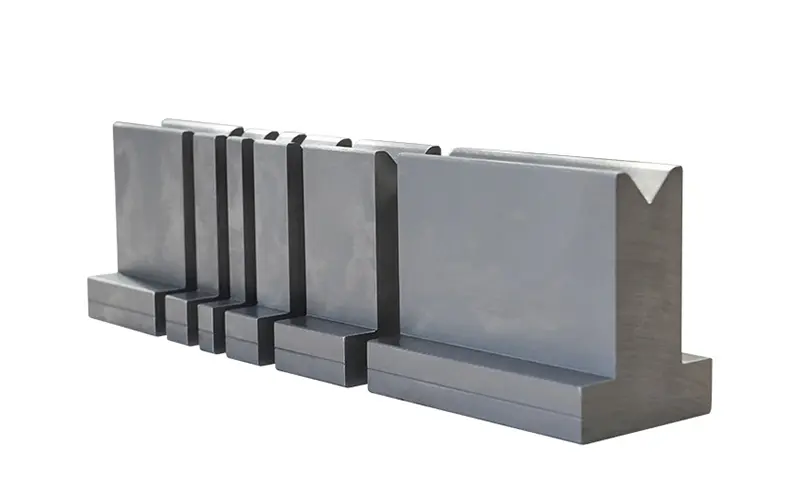
Heavy-duty punches and dies must be selected according to the material, bending force, radius, and required profile.
Why Tandem Configuration Can Be Valuable for European Fabricators
For manufacturers processing both conventional and oversized parts, a Tandem Press Brake can provide a useful balance between capacity and flexibility.
Its potential benefits include:
Extended bending length
Process workpieces beyond the practical length of many conventional single machines.
High bending capacity
Configure the system for demanding structural-steel applications.
Synchronized production
Coordinate multiple bending axes through CNC control and position feedback.
Production flexibility
A properly designed system can support a wider range of large fabricated components.
Automation potential
Advanced CNC, back gauges, support systems, angle measurement, and material-handling solutions can further improve the production process.
How to Specify a Tandem Press Brake for Heavy-Duty Applications
Before requesting a quotation, provide your machine manufacturer with more than just the desired tonnage.
The most useful information includes:
Material grade + maximum thickness + maximum bending length + part drawing + required bending angle/radius + annual production volume.
For European infrastructure projects, also discuss required machine safety, electrical specifications, documentation, tooling, installation, operator training, and applicable conformity requirements.
The manufacturer can then calculate the required bending force and recommend an appropriate machine configuration.
Building a More Efficient Heavy-Fabrication Process
A Tandem Press Brake is not simply a larger press brake.
Its value comes from combining extended working length with synchronized CNC control, heavy-duty machine construction, position feedback, suitable tooling, and compensation technology.
For European infrastructure and wind-energy manufacturers processing long structural components, the right tandem bending system can help improve capacity, repeatability, flexibility, and production efficiency.
At the same time, machine selection should always begin with the actual component—not a standard machine specification.
Send MIHARMLE your part drawing, material grade, plate thickness, bending length, bending radius, and production requirements. Our engineers can evaluate the required tonnage, working length, tooling, CNC synchronization, and machine configuration for your heavy-duty bending application.