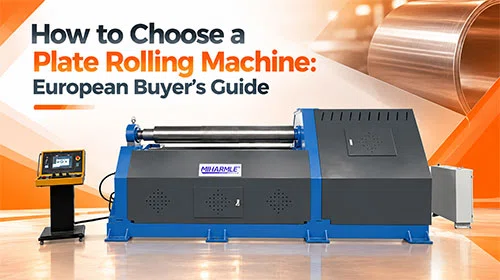
Choosing a Plate Rolling Machine Is More Than Comparing Thickness and Length
When European fabricators purchase a Plate Rolling Machine, two specifications often receive the most attention:
Maximum plate thickness + maximum working width.
But these numbers alone are not enough to select the right machine.
Two machines advertised as “20 × 3000 mm” can perform very differently when rolling stainless steel, high-strength steel, small diameters, or components requiring accurate pre-bending.
For pressure vessels, storage tanks, boilers, wind-energy components, shipbuilding, and structural fabrication, buyers should evaluate the material, rolling diameter, pre-bending capacity, straight-end requirement, production volume, controls, safety, and after-sales support before comparing prices.
Pain Point 1: “Can the Machine Really Roll My Maximum Thickness?”
This is one of the most important questions to ask a supplier.
The rolling capacity of a machine depends on more than nominal plate thickness.
It is affected by:
- Material yield strength
- Plate width
- Required finished diameter
- Roll diameter
- Rolling method
- Pre-bending requirement
For example, a machine capable of rolling a certain thickness of mild steel does not automatically provide the same capacity when processing higher-strength material.
Therefore, European buyers should provide the supplier with:
Material grade + yield strength + maximum thickness + plate width + minimum finished diameter.
A reliable manufacturer should select the machine based on the actual workpiece rather than simply recommend the closest catalogue model.
Pain Point 2: 3-Roll or 4-Roll Plate Rolling Machine?
This is one of the most common purchasing decisions.
3-Roll Plate Rolling Machine
A 3-roll plate rolling machine can be an economical and flexible solution for many general fabrication applications.
It is suitable when:
- Production volume is moderate
- Budget is an important consideration
- Operators have rolling experience
- The workpiece does not require highly automated handling
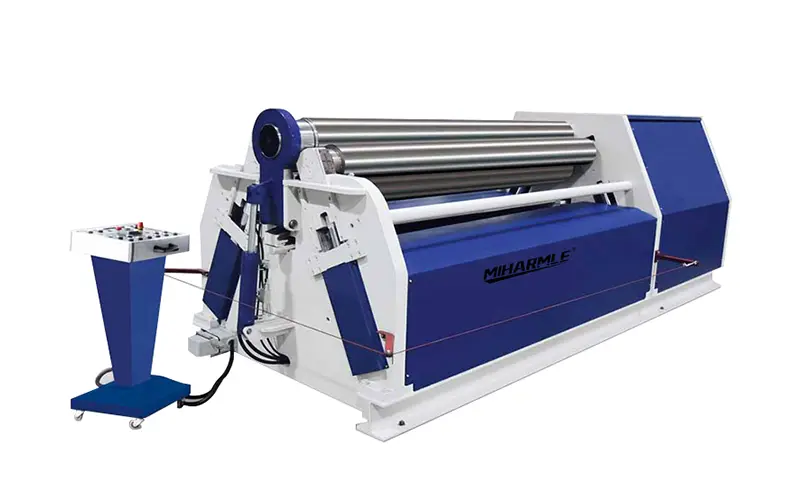
4-Roll Plate Rolling Machine
A 4-roll plate rolling machine provides additional control of the plate during feeding, pre-bending, and rolling.
The plate can be held between the top and bottom rolls while the side rolls control the bending process.
This can make a 4-roll configuration attractive for:
- Higher production volumes
- Repetitive cylindrical parts
- Automated production
- Improved material handling
- Applications where consistent pre-bending is important
The right choice is therefore not simply 3 rolls vs 4 rolls. It depends on production volume, operator skill, automation requirements, and the geometry of the finished part.
Pain Point 3: Excessive Straight Ends After Rolling
Customers often focus on the final diameter but overlook the unbent straight section at the plate edge.
Before the plate becomes a complete cylinder, its leading and trailing edges need to be pre-bent.
Poor pre-bending can leave excessive straight ends, creating additional work before welding.
This can lead to:
More correction → More fitting → More welding preparation → Longer production time
For tanks, pressure vessels, and cylindrical components, ask the manufacturer specifically about the machine’s pre-bending capacity, not only its maximum rolling capacity.
The required straight-end tolerance should ideally be discussed using your actual drawing.
Pain Point 4: Diameter Accuracy and Repeatability
Producing one acceptable cylinder is different from producing the same cylinder repeatedly.
Rolling accuracy can be affected by:
- Material thickness variation
- Material strength
- Roll positioning
- Springback
- Operator experience
- Machine rigidity
- CNC positioning
For manufacturers producing repeated components, a CNC or advanced control system can help operators save and reproduce rolling parameters.
However, CNC alone does not guarantee a perfect cylinder.
The mechanical structure, hydraulic system, roll positioning accuracy, material consistency, and correct process settings all influence the finished result.
Pain Point 5: Handling Large and Heavy Plates Safely
As plate thickness and width increase, material handling becomes a major production issue.
Large cylindrical parts may require additional support during rolling to prevent their own weight from affecting the process.
Depending on the application, a rolling system can be equipped with:
- Side supports
- Overhead supports
- Feeding tables
- Material handling systems
- Safety devices
For large-diameter tanks and heavy cylinders, these accessories should be considered during machine selection—not after the machine arrives.
A lower machine price can quickly lose its advantage if the factory later discovers that additional handling equipment is required.
Pain Point 6: European Safety and Compliance Requirements
For European customers, machine safety should be discussed at the quotation stage.
Buyers should confirm the applicable conformity requirements, safety devices, electrical configuration, documentation, and guarding according to the machine configuration and destination market.
Depending on the machine, safety features may include emergency-stop systems, safety ropes or devices around the working area, electrical protection, operating warnings, and other protective measures.
For machinery placed on the EU market, also pay attention to the transition to Regulation (EU) 2023/1230, which applies from 20 January 2027.
Do not simply ask:
“Does the machine have CE?”
Ask what safety configuration, documentation, electrical drawings, manuals, and conformity documentation will actually be delivered with the machine.
Pain Point 7: Installation and After-Sales Support From China
For a European buyer, purchasing price is only one part of the total machine cost.
A machine that cannot be installed, calibrated, or supported efficiently can create expensive downtime.
Before ordering, confirm:
- Installation requirements
- Foundation requirements
- Electrical specifications
- Hydraulic documentation
- Operating manuals
- Spare-parts availability
- Remote troubleshooting
- Engineer support if required
- Operator training
It is also valuable to request a Factory Acceptance Test (FAT) before shipment.
Whenever practical, the supplier should test a workpiece close to the customer’s actual material, thickness, width, and target diameter.
What Information Should You Send for an Accurate Quotation?
Instead of requesting only “a 20 mm plate rolling machine,” provide the following:
01 — Material: S235, S355, stainless steel or another grade?
02 — Maximum thickness: What is the actual production thickness?
03 — Maximum width: 2000, 2500, 3000, 4000 mm or more?
04 — Minimum diameter: What is the smallest required finished diameter?
05 — Pre-bending: What straight-end requirement do you have?
06 — Production volume: Occasional fabrication or repetitive production?
07 — Finished part: Tank, pressure vessel, pipe, cone, wind-energy component or structural part?
These seven details allow the manufacturer to recommend a much more appropriate machine.
Final Recommendation for European Buyers
The best Plate Rolling Machine is not necessarily the machine with the largest advertised capacity or lowest purchase price.
It is the machine that can reliably process your actual material, thickness, width, minimum diameter, and production volume while meeting your requirements for pre-bending, repeatability, safety, and long-term support.
For general fabrication, a 3-roll machine may provide an excellent balance between capability and investment.
For manufacturers requiring higher productivity, easier material control, and greater automation, a 4-roll CNC plate rolling machine may offer a stronger long-term solution.
Before selecting a machine, send MIHARMLE your:
Material + Thickness + Width + Minimum Diameter + Part Drawing + Production Volume
Our engineers can evaluate the rolling force, roll dimensions, pre-bending requirements, machine structure, CNC configuration, and material-handling options according to your actual application.
MIHARMLE Plate Rolling Machines → Request a Technical Solution