
Introduction
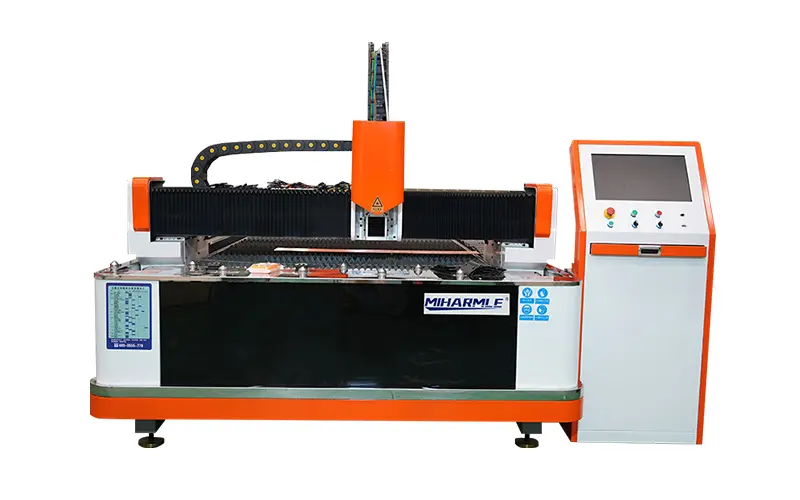
A fiber laser cutter is a highly efficient and precise cutting system. With its CNC controller, which drives the laser cutter head, it can produce clean, tight kerf widths and high-speed cuts. Although with such precision, if you don’t know how thick your fiber laser can cut with a certain power, it can ultimately limit your efficiency.
With just guesswork, you can risk scrap, rough edges, heat warping, and costly downtime. Precisely, the fibre laser cutting machine can cut different thicknesses depending on its power. It can easily cut stainless steel sheets 1mm thick to 50mm thick. While handling a range of materials, using different gases such as compressed air, oxygen, nitrogen, etc, for smooth, clean cuts.
With all this, the question still remains: How Thick Can a Fiber Laser Cut? The answer is not as simple; it depends on various factors.
This guide provides a comprehensive answer to your question, backed by all the information you need.
Let’s explore the thickness of the fiber laser cutter at different powers and the key factors that determine it.
What is fiber laser cutting?

Known for its efficiency, fiber laser cutting is a thermal cutting process that leverages advanced technology. It cuts materials cleanly through its highly intense, concentrated laser beam. A CNC controller controls the beam produced by the focused fiber-optic laser source. The beam, with high-speed cutting power, cuts the material with perfect accuracy when directed into it, producing smooth edges and lower scrap rates.
It excels at handling a wide range of materials, including stainless steel, carbon steel, brass, gold, silver, copper, and various alloys. That’s why this advanced technology has found applications spanning from aerospace, electronics, metal fabrication, and more.
How thick can a fiber laser cut?
In short, the maximum thickness a powerful laser cutter can handle is 50 mm for a given material.
Although, as discussed earlier, there is no absolute answer. Thickness capability comes down to a few critical elements. Wattage and material choice determine the maximum depth you can reach.
There are different types of fiber laser cutters available. For example, we have:
Entry-level fiber laser cutters can handle thin, soft metal sheets such as aluminum or brass. At the same time, high-powered fiber-cutting machines can handle stainless steel well. Then, there are ultra-high-powered fiber laser cutters. With such high power, they cut thicker metals, carbon steels with optimized process windows. In addition to these, various other factors come into play.
Key factors affecting cutting thickness
Other than the laser power and material type, the cutting thickness depends on several interacting variables. They involve assisted gases, focus position, laser cutting speed, bean quality, and others. Understanding each one helps you push limits safely while maintaining edge quality and production speed. Let’s discuss all of them in detail.
Laser power
Power is the most direct factor. Here, power refers to the thermal energy used to melt or vaporize the material. Therefore, higher wattage delivers more energy into the kerf, enabling penetration into thicker sections.
Here is an example. A 1000 W machine handles thin sheet metal just fine. But once you move up to 6000 W or 12,000 W, you can tackle plates 25 mm thick or more. A higher power also costs more upfront and draws more electricity, so choose the wattage that matches your typical jobs.
Material type and properties
Not all metals behave the same under the beam. There are different types of metal, like softer and harder ones. Of course, the harder ones, like carbon steel, absorb laser energy easily and work well with oxygen assist. That’s why it reaches the greatest thickness for a given power level. On the other hand, Aluminum and copper bounce a lot of light back because they’re reflective and conduct heat quickly. So you need more watts—and sometimes special optics—to cut them as deep.
Beyond the type, material properties also count. Melting point, thermal conductivity, and reflective properties all play into how the laser couples with the metal.
Assisted gas type and pressure
Gas choice changes everything. Oxygen, nitrogen, and compressed air are used as gases. The assist gas you use impacts the cutting thickness results.. Pressure and purity of the assisted gas matter, too. Higher pressure and purer gas give smooth cutting edges. Oxygen is best for carbon steel, while Nitrogen keeps stainless and aluminum edges clean and bright by blocking oxidation.
Focus position, lens quality, and beam quality
Focus puts all that energy into a tiny, intense spot. Using a well-focused beam will easily penetrate the material. Dirty or scratched lenses scatter the beam, wasting power. So keeping the optical lens clean is non-negotiable.
Beam quality (measured by the beam parameter product) indicates how tightly focused the beam is. High-quality beam delivers higher intensity and reaches deeper.
Nozzle diameter
Nozzle size controls how gas flows around the beam and is an important factor that impacts cutting thickness. While directing the beam, it helps remove molten material from the workpiece. This result is smooth and clean cuts. A smaller nozzle diameter works best for cutting thinner metals. However, for thicker metals, you will require a larger nozzle diameter.
Cutting speed and strategy
As you push toward the limit, slowing down gives energy more time to couple into the material. That extra dwell helps achieve full penetration and smoother edges on thick sections. Cutting too fast or going too slow wastes time without improving the result. A balanced cutting speed will give you consistent productivity, edge finish, and gas consumption across each thickness.
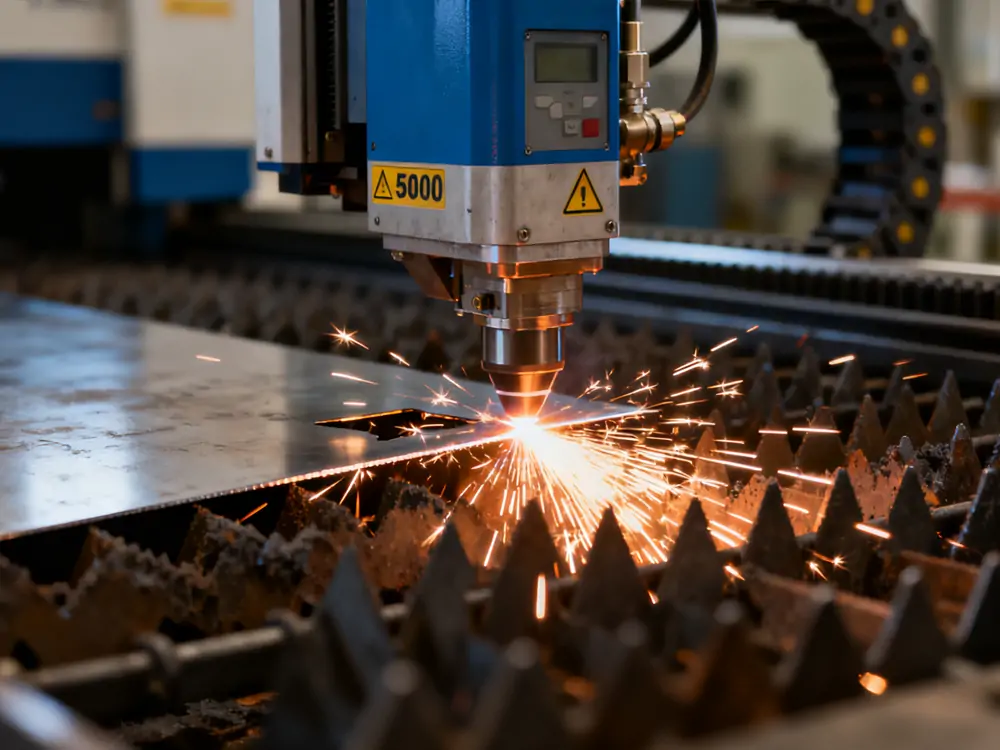
500W Fiber Laser Cutting Machine Cutting Thickness
A 500W fiber laser is an entry-level machine suited for thin-sheet metal work and precision work. It efficiently handles mild steel up to around 6mm. This laser power is ideal for light fabrication, prototyping, and fine detail cutting. Power consumption is low, but the thickness capability is limited compared to higher-wattage systems.
| Material | Max Cutting Thickness (mm) |
| Carbon Steel | 6 |
| Stainless Steel | 3 |
| Aluminum | 2 |
| Copper | 1 |
| Brass | 1 |
1000W Fiber Laser Cutting Machine Cutting Thickness
A 1000W fiber laser offers a step up in capability, reaching about 10mm in carbon steel with proper setup. This power level suits job shops handling thin to light-medium plate, balancing cost and performance for general fabrication. Aluminum cutting tops out around 3mm due to reflectivity and thermal properties.
| Material | Max Cutting Thickness (mm) |
| Carbon Steel | 10 |
| Stainless Steel | 5 |
| Aluminum | 3 |
| Copper | 2 |
| Brass | 2 |
1500W Fiber Laser Cutting Machine Cutting Thickness
A 1500W fiber laser bridges entry and mid-range capacity, pushing carbon steel up to roughly 12-14mm. This wattage handles a wider mix of sheet and light plate work, offering faster speeds on thin materials and acceptable performance on medium sections. Stainless and aluminum thicknesses improve moderately compared to 1000W systems.
| Material | Max Cutting Thickness (mm) |
| Carbon Steel | 14 |
| Stainless Steel | 6 |
| Aluminum | 4 |
| Copper | 3 |
| Brass | 3 |
2000W Fiber Laser Cutting Machine Cutting Thickness
A 2000W fiber laser is a highly flexible workhorse for most fabrication shops, as it can cut mild steel up to approximately 16mm and cut stainless steel up to approximately 6mm with quality and high speed. This power level strikes a balance between initial cost, operating expense, and throughput where mixed production work is required. Aluminum is available up to about 5mm thick, whereas reflective metals such as copper are difficult to work with.
| Material | Max Cutting Thickness (mm) |
| Carbon Steel | 16 |
| Stainless Steel | 6 |
| Aluminum | 5 |
| Copper | 3 |
| Brass | 3 |
4000W Fiber Laser Cutting Machine Cutting Thickness
A 4000 W fiber laser delivers significant cutting power, up to 30mm in carbon steel, 12mm in stainless steel, and 10mm in aluminum. This power category deals with heavy fabrication, automotive, and structural work, where the speeds are higher and the edges of the work are cleaner on the heavy plate. The costs of operation increase, though the increase in productivity usually compensates for the investment.
| Material | Max Cutting Thickness (mm) |
| Carbon Steel | 30 |
| Stainless Steel | 12 |
| Aluminum | 10 |
| Copper | 6 |
| Brass | 6 |
5000W Fiber Laser Cutting Machine Cutting Thickness
A fiber laser with a 5000W can handle even more extreme cuts, cutting through carbon steel to 35mm, stainless steel to 14mm, and aluminum to 12mm. This power is appropriate in high-volume production shops that frequently use thick plates and require high cycle times. Copper and brass cutting is upgraded to approximately 8mm to increase the versatility of materials used in special purposes.
| Material | Max Cutting Thickness (mm) |
| Carbon Steel | 35 |
| Stainless Steel | 14 |
| Aluminum | 12 |
| Copper | 8 |
| Brass | 8 |
Maximum cutting thickness of different materials
Fiber lasers handle metals best, but the thickness varies widely by material. Carbon steel cuts deepest because it absorbs energy well and reacts with oxygen. Stainless steel, aluminum, and copper need more power due to their reflectivity and thermal properties.
Carbon steel
Carbon steel is the easiest metal to cut. Oxygen assist adds heat through a chemical reaction, boosting thickness. Most machines reach 25-30 mm at mid power, while ultra-high systems push past 100 mm. Edge quality stays clean up to about 25 mm; beyond that, speed drops and taper increases.
Stainless steel
Stainless steel requires nitrogen to prevent oxidation and keep edges bright. Maximum thickness runs about 60-70% of carbon steel at the same wattage. A 6000W machine cuts roughly 15-20 mm, while a 20,000W machine reaches 60 mm. Cutting speed is slower than that of carbon steel due to higher strength.
Aluminum
Aluminum reflects light and conducts heat quickly, demanding careful setup. Thickness caps lower than stainless at equal power. Expect around 10-12 mm at 4000-5000W, 40-50 mm at 15,000-20,000W. Nitrogen assist is standard to maintain clean, oxide-free cuts.
Copper and brass
Copper and brass are the most challenging due to extreme reflectivity and conductivity. Low-power machines struggle; 500-1000W systems cut only 1-2 mm copper. High-power systems reach 20-25 mm at 15,000-20,000W, and 30-40
mm at 30,000-40,000W. Special coatings or fiber wavelengths improve absorption.
Comparison table
| Material | 1000W | 4000W | 6000W | 15,000W | 30,000W |
| Carbon Steel | 10 mm | 20 mm | 25 mm | 50-60 mm | 80-100 mm |
| Stainless Steel | 5 mm | 10-12 mm | 15-16 mm | 40-50 mm | 60-70 mm |
| Aluminum | 3 mm | 8-10 mm | 16-20 mm | 30-40 mm | 50-60 mm |
| Copper | 2 mm | 5-6 mm | 8-10 mm | 15-20 mm | 25-30 mm |
| Brass | 2 mm | 5-6 mm | 8-10 mm | 15-20 mm | 25-30 mm |
Conclusion
While a fiber laser cutter is an advanced machine, it can cut various thicknesses depending on multiple factors. These factors include laser power, material, cutting speed, assist gas, laser beam quality, lens, and more. If we talk about the maximum thickness a laser cutter can cut, we can generally conclude that it is 50mm for specific metals, depending on the laser power. It is very important to know the actual cutting thickness that your fiber laser machine can cut. It will help you achieve your target and provide accurate, clean cuts and smooth edges as needed. Before your next purchase, match the laser power to your typical material mix and thickness range for optimal results.