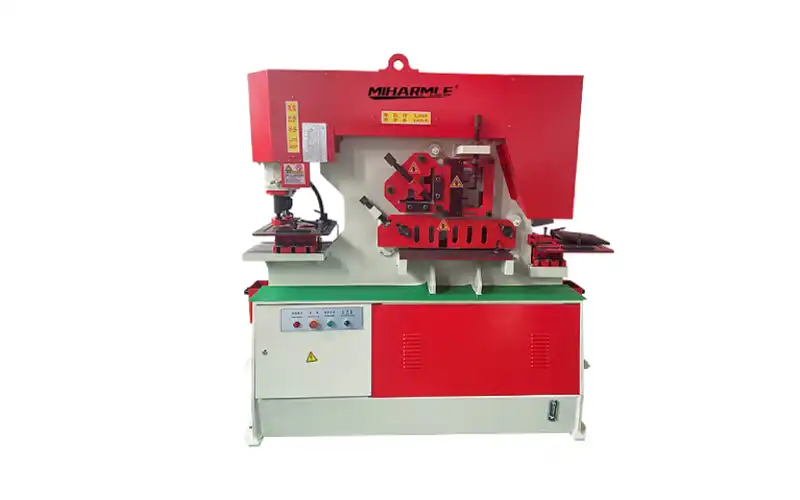
Introduction
When discussing metal fabrication, we often come across shearing machines. These machines are widely popular. They help you cut, trim, and shape metal and sheet metal efficiently. If you work with metal or sheet metal, using the right shears can really matter.
These machines can help in many ways. They can increase speed and correctness in no time. They help you lessen material waste and increase safety.
When you are using shearing machines, you can work with many materials. There are many types of shearing machines. If you know them all, you can easily make the right choice for your work purpose. This will consequently help you grow.
This guide covers many types of shearing machines and their working. It also includes its main benefits and applications.

Types of Shearing Machines
Guillotine Shearing Machines
Guillotine Shearing Machines are widely regarded as a popular type of metal shearing machine. They have a straight blade and a bottom fixed blade. Both these blades perform well when cutting your materials. They have been known to cut small, medium, and large sheets very easily. They come in three types: foot-powered, hydraulic, and mechanical.
They are famous for their fast results. This enables them to be popular and produce large amounts. There is a slight weakness in that they create rough edges. Thus, additional polishing may be required. They are normally applied where speed and cost are the most important. They do not come in handy for aesthetic purposes. They are applicable in automobiles, domestic appliances,s and buildings.
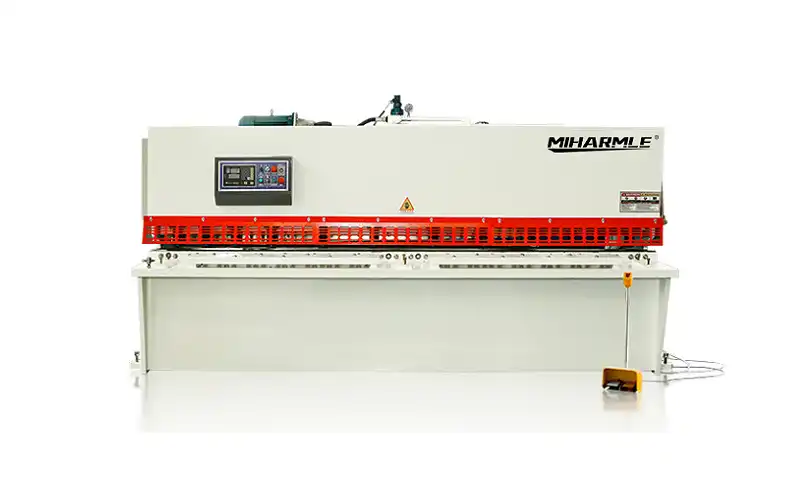
Hydraulic Shearing Machines
Hydraulic shearing machines have a hydraulic cylinder to slide the blade. The best part is that you can easily adjust the cutting force settings. You can set it by thickness and the type of metal used. They can easily go with stainless steel, high-strength steel,l and other strong materials. As opposed to the guillotine, they provide you with fine and sharp edges.
Another good feature is that they have safety features. These may include overload protection and emergency stops. Heavy industries use hydraulic shearing machines. These are shipbuilding, bridge construction and mass production. They are accurate, powerful,l and safe.
Mechanical Shearing Machines
Mechanical shearing machines use an electric motor and a flywheel. They are both used to spin the blade. The rotary motion is converted to the reciprocating linear motion of cutting. They are effective in straight cuts on medium-thickness plates. They turn out quickly and can handle continuous production.
Their cutting power is constant, so when overloaded, the machine will break down. They can be applied in such industries where an average accuracy is required. These include the creation of a large number of steel structures and containers.
CNC / NC Shearing Machines
Shearing machines are automated by CNC machines or NC machines. The movement of the blade and the cutting patterns are controlled by a computer. The machines are used to cut complicated shapes with the fewest errors. They increase productivity, reduce materials’ wastage, and require the least human control.
CNC shearing machines allow you to adjust settings based on material or thickness. This helps a lot when doing a job repeatedly and precisely. They are used in sheet metal and plates. They are also used to produce specialized parts for cars, planes, and appliances.
Alligator Shears
Alligator shears are named for their hinged jaw-like shape. These are either mechanically or hydraulically driven. These machines cut long metal stock such as I-beams, angle iron, pipe, and scrap metal.
Alligator shears are useful for recycling materials and preparing heavy metals. They are rough and strong, but inaccurate. They are used much where a high level of finish is not important. They will be applied when a high level of finish is not necessary. They are also helpful when you are working with metal that you plan to continue working on.
Power Shears
Power shears are hand-operated, but may be powered by electricity or air to propel the blade. They work efficiently, either cutting straight lines or massive curves in sheet metal. Power shears are more precise in the process and offer a superior finish compared to manual snips.
They will be employed in the medium-sized sheets in workshops or smaller production plants. They are also flexible, so you can make straight and round cuts without having to switch tools.
Rotary Shears
Rotary shears are tools for cutting metal sheets continuously with rotating circular blades. They are extensively applicable in steel strip processing and in enormous production. These are time-saving, labor-saving machines.
Continuous, straight, long cuts of coils or sheets will be made with rotary shears. They are also highly efficient, with consistent cut quality.
How Do Shearing Machines Work?
Shearing machines operate by pushing the material using a pair of blades. The blade moves down against a fixed lower blade, making a clean cut. The quality of the cut is dependent on blade clearance, shear angle, and cutting speed.
The Hydraulic and CNC machines can be adjusted to the metal type and thickness with force and speed. Mechanical and manual machines can be precise only to the extent of the operator’s capability. The same principle applies to all types of metal shearing machines. But each of them has different applications depending on the power source and design.
Advantages of Using Shearing Machines
There are some advantages of the use of shearing machines:
- Precision and Accuracy: The blades make clean, straight cuts, meeting the needs.
- Productivity: Machines are efficient in terms of time and manpower in processing.
- Material Savings: With proper cuts, waste will be reduced, and production costs will decrease.
- Versatility: It applies to sheets, plates, and rods, among others.
- Safety: New shearing machines are equipped with emergency stops, guards, and overload protection.
- Automation: CNC and hydraulic machines will reduce labor costs and improve accuracy.
Applications of Shearing Machines

In the industries, shearing machines are very common in:
- Sheet Metal Fabrication: Bending, welding, or assembling metal sheets into smaller components.
- Plate Cutting: Construction, machinery, and shipbuilding.
- Steel Rolling Mills: Bending bars, rods, and slabs to the needed length.
- Scrap Metal Recycling: Preparation of metal for scrapping or recycling.
- Home Appliances and Electronics: Casing and panels by cutting thin sheets.
- Automotive and Aerospace: Highly accurate cutting of panels, components, and structural components.
Each application needs a specific type of shearing machine.
- For large production, guillotines or hydraulic machines can be used.
- For making complex parts, CNC shearing machines are most accurate.
- For smaller and irregular work cutting, power and manual shears are used.
Using the right machine improves quality. It also helps reduce waste and increase production and efficiency.
Conclusion
In most metalworking operations, shearing machines are used. They make cuts efficiently, accurately, and safely. When you know all the types of shearing machines better, you know exactly where to use which one. A few factors may include material, thickness, and production needs.
A few types of metal shearing machines include guillotine, hydraulic, mechanical, CNC, and alligator. Each of them has unique benefits. Knowing each of them can reduce waste, increase speed and productivity. It maintains a smooth, uniform workflow.
Shearing machines are used in workshops, factories, and steel mills. Choose the right kind of machine increase your efficacy and quality. It further reduces labor costs. When you are considering working with thin sheet metal or steel rods, shearing machines are the best option for your project.