
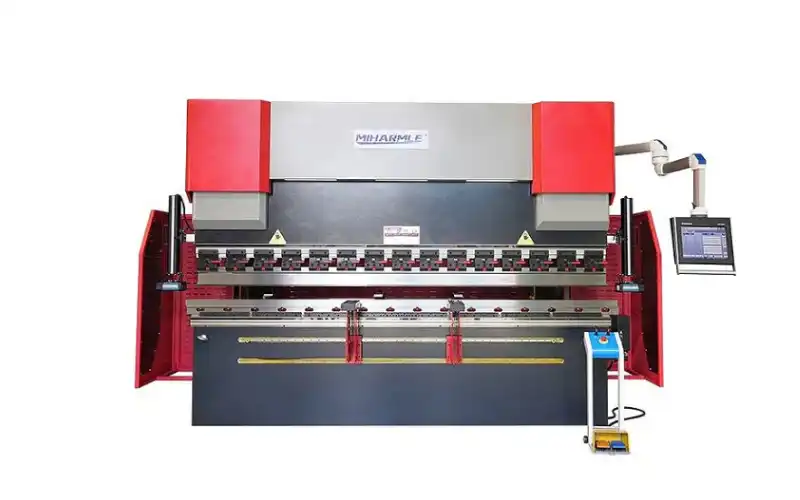
When buying a CNC press brake, many customers focus on parameters such as bending tonnage, bending length, the control system brand, and tooling configuration, yet often overlook the number of CNC axes on the back gauge system.
Backgauge configurations typically include 3, 4, or 6 axes, each offering a different processing scope. A low axis count may limit production flexibility, while an excessive number of axes increases equipment costs; therefore, selecting the right configuration for your needs is crucial.
This guide details the differences between 3-axis, 4-axis, and 6-axis systems, explains the operating principles of the X, R, Z1, and Z2 axes, and outlines the types of workpieces best suited for each configuration.

What Do CNC Press Brake Axes Mean?
In a CNC press brake, the axes control the movement of the ram and the back gauge. The back gauge is responsible for positioning the sheet metal before each bend. The more complex your parts are, the more important the back gauge becomes.
Common press brake axes include:
- Y1/Y2 axis: controls the left and right cylinders of the ram
- X axis: controls front-back movement of the back gauge
- R axis: controls up-down movement of the back gauge fingers
- Z1/Z2 axis: controls left-right movement of the back gauge fingers
- X1/X2 axis: allows independent front-back movement of each gauge finger on advanced systems
In many cases, when people talk about 3-axis, 4-axis, or 6-axis press brakes, they are mainly discussing the level of automation and flexibility of the back gauge system.
3-Axis CNC Press Brake: Simple, Reliable, and Cost-Effective
A typical 3-axis CNC press brake usually includes:
- Y1
- Y2
- X axis
This means the ram is controlled by Y1 and Y2, while the back gauge moves forward and backward through the X axis.
Best for Simple and Regular Parts
A 3-axis CNC press brake is suitable for workpieces with simple bending requirements, especially when the flange dimensions are regular and the back gauge only needs to move in one direction.
Typical applications include:
- Simple brackets
- Electrical cabinet panels
- Door panels
- Basic enclosures
- Straight bending parts
- Repetitive sheet metal components
Advantages of 3-Axis Press Brakes
The biggest advantage is cost control. A 3-axis machine is usually more affordable, easier to operate, and easier to maintain.
For factories producing simple parts in large quantities, a 3-axis CNC press brake can be a very practical choice. It gives you stable bending performance without paying for advanced axes that may rarely be used.
Limitations of 3-Axis Press Brakes
The main limitation is flexibility. Since the back gauge cannot automatically move up and down or adjust finger positions independently, operators may need more manual adjustment for complex parts.
If your workpieces have multiple bend heights, irregular flanges, or non-symmetrical positioning requirements, a 3-axis machine may slow down production.
4-Axis CNC Press Brake: Better Flexibility with R Axis Control
A common 4-axis CNC press brake configuration includes:
- Y1
- Y2
- X axis
- R axis
Compared with a 3-axis machine, the key upgrade is the R axis, which controls the vertical movement of the back gauge.
Why the R Axis Matters
The R axis allows the back gauge fingers to move up and down automatically. This is very useful when bending parts with different flange heights or when the reference surface is not always at the same level.
Instead of manually adjusting the back gauge height, the CNC system can automatically position it according to the bending program.
Best for Medium-Complexity Sheet Metal Parts
A 4-axis CNC press brake is suitable for factories that process more varied products but still want to keep machine cost under control.
Typical applications include:
- Electrical enclosures
- Elevator panels
- HVAC sheet metal parts
- Stainless steel covers
- Furniture metal parts
- Medium-complexity cabinets
- Parts with different flange heights
Advantages of 4-Axis Press Brakes
A 4-axis press brake offers a good balance between cost and flexibility. For many sheet metal workshops, this is the most practical upgrade from a basic machine.
It improves positioning efficiency, reduces manual adjustment, and makes multi-step bending more consistent.
When Should You Choose 4-Axis?
Choose a 4-axis CNC press brake if your parts are not extremely complex, but you often process different product sizes, different flange heights, or small-batch custom orders.
For many job shops, 4-axis is the “sweet spot” between price and performance.
6-Axis CNC Press Brake: High Efficiency for Complex and Flexible Production
A typical 6-axis CNC press brake may include:
- Y1
- Y2
- X axis
- R axis
- Z1 axis
- Z2 axis
The biggest difference is the addition of Z1 and Z2 axes, which control the left-right movement of the back gauge fingers.
What Do Z1 and Z2 Axes Do?
Z1 and Z2 allow the back gauge fingers to move independently along the machine length.
This is especially useful when bending parts with different widths, asymmetric shapes, or multiple bending positions. The machine can automatically adjust the finger positions according to the program, reducing setup time and improving repeatability.
Best for Complex and High-Mix Production
A 6-axis CNC press brake is ideal for factories that produce many different types of parts and need fast changeover.
Typical applications include:
- Complex enclosures
- Precision cabinets
- Irregular sheet metal parts
- Multi-bend components
- Small-batch high-mix production
- Parts requiring frequent back gauge repositioning
- Automated or semi-automated bending lines
Advantages of 6-Axis Press Brakes
The main advantage is production efficiency. Operators spend less time adjusting back gauge fingers manually, and bending programs can be repeated with higher consistency.
For factories handling frequent product changes, a 6-axis CNC press brake can reduce setup time and improve overall productivity.
Is 6-Axis Always Better?
Not always.
If your workpieces are simple and repetitive, a 6-axis machine may not bring enough return on investment. The extra axes increase the machine price, maintenance requirements, and programming complexity.
A 6-axis CNC press brake is most valuable when your production requires flexibility, precision, and fast setup for different parts.
Quick Comparison: 3-Axis vs 4-Axis vs 6-Axis Press Brake
| Configuration | Common Axes | Best For | Main Advantage |
|---|---|---|---|
| 3-Axis | Y1, Y2, X | Simple and regular parts | Lowest cost, easy operation |
| 4-Axis | Y1, Y2, X, R | Medium-complexity parts | Better flexibility and positioning |
| 6-Axis | Y1, Y2, X, R, Z1, Z2 | Complex and high-mix production | Fast setup, higher automation |
How to Choose the Right Axis Configuration
Before choosing a CNC press brake, you should consider your actual workpieces, not just the machine specification.
Ask these questions:
- Are your parts simple or complex?
- Do your workpieces have different flange heights?
- Do you often change product types?
- Are your parts symmetrical or irregular?
- Do you need fast setup for small-batch production?
- Is your priority low investment cost or long-term efficiency?
If most of your parts are simple panels or brackets, a 3-axis machine may be enough.
If your factory processes different product types and needs better positioning flexibility, a 4-axis press brake is often a better choice.
If your production involves complex parts, frequent changeovers, and high accuracy requirements, a 6-axis CNC press brake can bring stronger long-term value.
Don’t Pay for Axes You Don’t Need
More CNC axes do not always mean better value. The best press brake configuration is the one that matches your real production needs.
Some customers spend extra money on 6-axis machines but only use them for simple straight bending. Others choose a basic 3-axis machine and later find that manual adjustment takes too much time for complex jobs.
The right choice should be based on your drawings, material thickness, bending sequence, part size, and production volume.
Upload Your CAD Drawings for a Free Axis Configuration Plan
Not sure whether you need a 3-axis, 4-axis, or 6-axis CNC press brake?
Send us your workpiece CAD drawings, and our engineering team can help analyze your bending requirements. Based on your part structure, bend sequence, material thickness, and production volume, we will recommend the most cost-effective axis configuration for your needs.
You do not need to overpay for unnecessary axes. You only need the right machine for your actual production.
Upload your CAD drawing today and get a free CNC press brake configuration plan.