
Many customers are unsure how to choose between 3-roll and 4-roll plate bending machines. The decision primarily depends on the equipment’s structure, production speed, machining precision, and your budget; you need to match the machine to your daily production requirements.
Plate rolling machines are used to roll metal sheets into cylinders, cones, arcs, storage tanks, and other curved workpieces. Three-roll and four-roll plate rolling machines differ in their methods of clamping and rolling the material, factors that directly impact production efficiency.
Today, let’s take a look at three-roll and four-roll plate bending machines to help you choose the best equipment.
What Is a 3-Roll Plate Rolling Machine?
A 3-roll plate rolling machine uses three rollers to bend sheet metal or metal plate into a required radius. Depending on the machine design, it may use one upper roll and two lower rolls, or a different arrangement such as asymmetrical or variable-geometry rolls.
The plate is passed between the rolls, and pressure is applied to gradually form the curve. In many 3-roll machines, pre-bending the plate ends requires extra handling, repositioning, or multiple passes.

Main Advantages of a 3-Roll Plate Rolling Machine
A 3-roll machine is often chosen because it is simple, reliable, and cost-effective.
Key advantages include:
- Lower initial investment compared with many 4-roll machines
- Simple mechanical structure and easier maintenance
- Good choice for general fabrication work
- Suitable for low-to-medium production volume
- Strong performance for many thick-plate and large-diameter rolling jobs
- Practical option when ultra-tight repeatability is not required
For workshops that handle different jobs, custom parts, repair work, or occasional rolling projects, a 3-roll plate rolling machine can be a very practical investment.
Limitations of a 3-Roll Plate Rolling Machine
The main limitation is efficiency during pre-bending. The operator may need to flip or reposition the plate to bend both ends. This takes time and increases the need for skilled operation.
Common limitations include:
- More manual handling
- Longer cycle time
- Larger remaining straight edge at plate ends
- Higher dependence on operator experience
- Less efficient for repeat production
- More setup work for accurate cylinders or cones
A 3-roll machine can still produce high-quality results, but it often requires more operator skill and more adjustment.
What Is a 4-Roll Plate Rolling Machine?
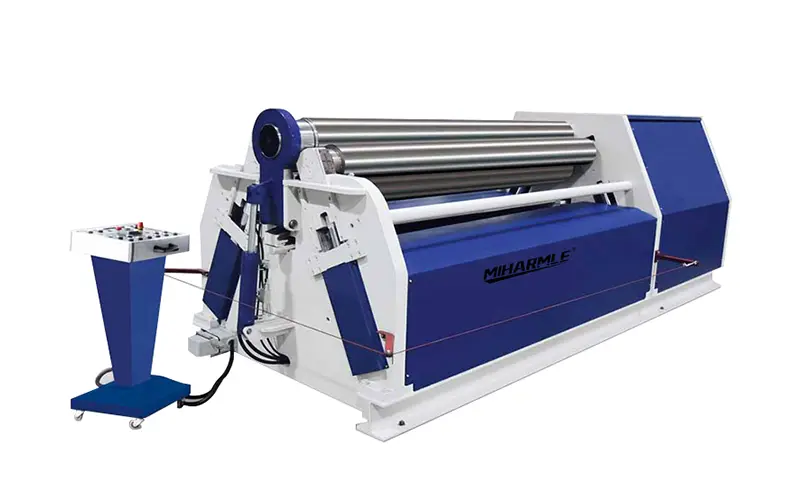
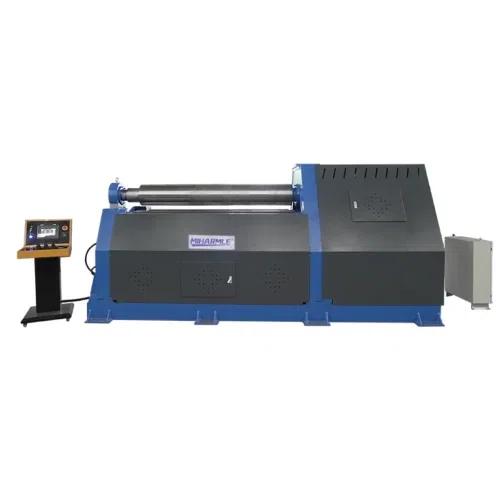
A 4-roll plate rolling machine normally has one top roll, one bottom pinch roll, and two side rolls. The plate is clamped between the top and bottom rolls, while the side rolls move to pre-bend and roll the material.
Because the plate stays securely pinched during the process, a 4-roll machine can usually complete pre-bending and rolling with less repositioning. Many modern 4-roll machines are also available with NC or CNC control for repeatable production.
Main Advantages of a 4-Roll Plate Rolling Machine
A 4-roll plate rolling machine is designed for higher productivity, better control, and more consistent results.
Key advantages include:
- Pre-bending and rolling in one setup
- Less manual plate handling
- Smaller straight edge at both ends
- Faster production cycle
- Better roundness and repeatability
- Easier operation for batch production
- Safer handling, especially for larger plates
- Better compatibility with CNC automation
For pressure vessels, storage tanks, wind tower sections, shipbuilding parts, and repeated cylinder production, a 4-roll machine is often the more efficient choice.
Limitations of a 4-Roll Plate Rolling Machine
The biggest disadvantage is cost. A 4-roll machine usually requires a higher purchase budget, more advanced hydraulic/control systems, and sometimes more maintenance knowledge.
Common limitations include:
- Higher initial investment
- More complex structure
- More advanced controls and hydraulic systems
- May be unnecessary for occasional or simple rolling jobs
- Higher requirements for machine setup and service support
If your shop only rolls plates occasionally, a 4-roll machine may not deliver enough return on investment.
3-Roll vs 4-Roll Plate Rolling Machine: Key Differences
| Factor | 3-Roll Plate Rolling Machine | 4-Roll Plate Rolling Machine |
|---|---|---|
| Roll structure | Three rolls | Four rolls |
| Plate gripping | Less continuous control | Plate is pinched more securely |
| Pre-bending | Often requires extra steps | Usually completed in one setup |
| Straight edge | Larger remaining straight edge | Smaller remaining straight edge |
| Production speed | Slower for repeat jobs | Faster and more efficient |
| Operator skill | Higher skill required | Easier with NC/CNC control |
| Accuracy | Good, but operator-dependent | Higher repeatability |
| Automation | Limited or moderate | Better for CNC automation |
| Cost | Lower investment | Higher investment |
| Best for | General fabrication, custom jobs, budget-sensitive shops | Batch production, precision parts, high-efficiency fabrication |
Which Machine Fits Your Job?
Choose a 3-roll plate rolling machine if:
- You need a lower-cost solution
- Your production volume is low or medium
- Your jobs change frequently
- You have skilled operators
- Slightly larger straight edges are acceptable
- You roll large-radius or general fabrication parts
- You want simpler maintenance
Choose a 4-roll plate rolling machine if:
- You need faster cycle times
- You produce cylinders or shells repeatedly
- You require better roundness and repeatability
- You want to reduce manual handling
- You need efficient pre-bending on both ends
- You plan to use NC or CNC control
- You manufacture pressure vessels, tanks, pipes, wind tower sections, or shipbuilding parts
Application Examples
A 3-roll plate rolling machine is commonly used for:
- General metal fabrication
- Steel structure components
- Large-diameter cylinders
- Agricultural machinery parts
- HVAC ducting
- Repair workshops
- Custom one-off parts
A 4-roll plate rolling machine is commonly used for:
- Pressure vessel shells
- Storage tanks
- Wind tower sections
- Shipbuilding components
- Truck tank bodies
- Oil and gas equipment
- Batch production of pipes and cylinders
- High-precision curved metal parts
Is a 4-Roll Machine Always Better?
Not always.
A 4-roll plate rolling machine is generally faster and more accurate, but that does not mean every workshop needs one. If your main jobs are custom, low-volume, or budget-sensitive, a 3-roll machine may be the smarter choice.
On the other hand, if your business depends on production efficiency, repeatable quality, and reduced handling time, the higher investment in a 4-roll machine can often be justified.
The best machine is the one that matches your plate thickness, plate width, minimum rolling diameter, material type, production volume, tolerance requirement, and available budget.
Questions to Ask Before Buying
Before choosing between a 3-roll and 4-roll plate rolling machine, ask these questions:
- What plate thickness and width do I roll most often?
- What is the minimum cylinder diameter required?
- Do I need pre-bending on both plate ends?
- How important is roundness and repeatability?
- Is my production mostly one-off work or batch production?
- How much operator experience is available?
- Do I need NC or CNC control?
- What is my expected return on investment?
- What materials will I roll: carbon steel, stainless steel, aluminum, or alloy plate?
- How much workshop space and handling equipment do I have?
Final Recommendation
In summary, if you prioritize cost-effectiveness, flexibility, and equipment reliability, a 3-roll plate rolling machine is recommended; however, if you place greater emphasis on production efficiency, high precision, reduced manual labor, and consistent bending quality, a 4-roll plate rolling machine is the preferred choice.
Three roll bending machine offers greater flexibility and lower investment costs, whereas four roller bending machine holds advantages in terms of speed, precision, automation, and production efficiency. Before purchasing, it is essential to comprehensively consider factors such as actual production requirements, the equipment’s bending and pre-bending capabilities, control systems, hydraulic performance, and after-sales service.