Introduction
Standard and gooseneck punches are among the two most popular types of punches used in sheet metal fabrication. In a press brake machine, punches are the upper tools that apply force to bend the metal sheets. Since the function of both punches is to give shape to the metal sheets, they have different designs to meet manufacturing needs.
Punch selection can be quite challenging because it directly affects bending quality, tooling life, and production efficiency. To evaluate bending performance, numerous fabrication shops rely on machine specifications. However, there is a significant role of tooling geometry.
So it is important to understand the features of both punches (standard and Gooseneck). So that it can help manufacturers improve productivity and avoid costly production issues.
The following discussion will be based on understanding the differences between them. That will help operators or manufacturers decide which to use for which purpose.
Role of Press Brake Punches in Sheet Metal Bending
The upper tooling part fitted in a press brake machine is called a press brake punch. In the bending process, the punch exerts a force on the sheet metal and forces it against the lower die.
The shape of the punch directly affects the bend angle and radius. Material flow, part geometry and tool accessibility are also main factors to be concerned about.
There are various punch designs that could be used to meet the bending needs. Selecting the wrong punch could lead to a serious problem. For example, press brake operators or manufacturers can experience reduced bending accuracy. It can also limit the types of sheet metal components that can be produced by punching.
What Is a Standard Punch?
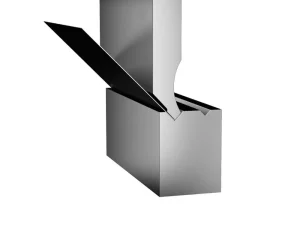
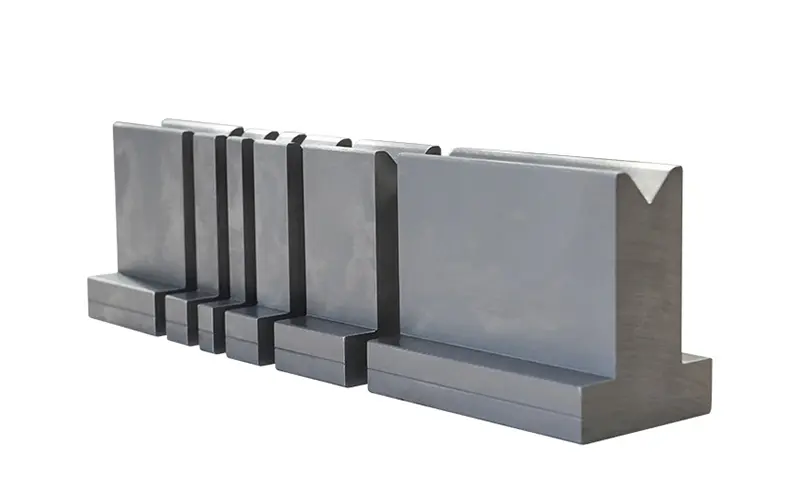
In press brake machines, the standard punch is a commonly used punch design. More precisely, it is a press brake tool with a straight, vertical body. It is used in general bending operations (bending metal sheets).
- One of the main characteristics of this punch includes its availability in multiple tip radii and angles.
- The structure of a standard punch is highly rigid. So, the geometry (body shape) of this punch offers high strength and good force distribution when bending.
- Standard punches are commonly used to form simple shapes, such as L- or U-shapes, in flat metal sheets.
- It is also used to bend metal sheets into a cross-sectional shape.
- There is also a wide use of standard punches in electrical cabinets, HVAC components, and industrial enclosures.
What is a Gooseneck Punch?
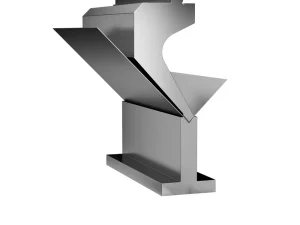
A gooseneck punch has a unique curved shape behind the punch tip. In the bending operation, the hollow, inward-pressed shape provides extra clearance.
- Its design enables the operator to bend complex parts. And it does this job without any collisions between the part and the punch body.
- The gooseneck punches are specifically designed for use with return flanges and deep box-shaped parts.
- Gooseneck punch is suitable for multi-stage bending operations. Other characteristics of these punches include a reduced risk of interference.
- There is a wide use of punches in deep box fabrication. These punches are also used in electrical enclosures. These are used in forming complex brackets and cabinets.
Key Differences Between Standard Punches and Gooseneck Punches
Design Differences:
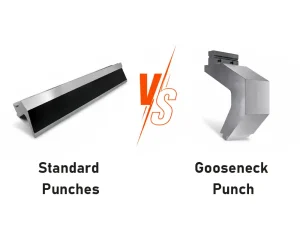
The main difference between the two kinds of tooling is their shapes.
- The design of a standard punch enables it to withstand heavy bending loads; the reason is its straight body shape. Other features of a standard punch design include simple force transmission. It has the strength to resist deflection.
- On the other hand, the gooseneck punch design offers improved accessibility. During bending, its curved neck profile offers additional clearance for the workpiece. It has greater flexibility with multiple bends. During operation, the curved section provides clearance for formed flanges and bent sections.
Clearance During Bending:
One of the most crucial considerations when choosing a punch is clearance. Here, clearance refers to the space created during bending between the punch and the already-bent metal part.
A standard punch offers limited clearance. Because standard punches have a straight body, less space is available around the bent part. So there is a greater chance of the bent part hitting the punch body when forming the next bend. The reason for reduced space is the production of deep channels or the formation of return flanges.
On the other hand, the gooseneck punch created more space around the bend part. Since it has a curved body, there are fewer chances of collision (between the bent metal part and the punch body). This makes it easy to produce deep profiles. It also increases flexibility during complex bending sequences. So there is a high demand for a gooseneck punch in a precision fabrication environment.
Bending Accuracy:
The right type of punching can provide high bending accuracy.
- Due to the higher structural rigidity of the standard punch, basic bending operations can be done with it. Because of reduced tool deflection, it is suitable for forming simple, straight metal sheets. Manufacturers can repeat the bending process using a standard punch.
- On the other hand, the recessed body shape of the gooseneck punch reduces rigidity. It is suitable for difficult bending operations.
But the difference in accuracy and rigidity can be minimized with modern tooling materials.
Production Flexibility:
- Manufacturers are increasingly demanding a flexible production system capable of producing a wide variety of product designs. Standard punch is best suited for high-volume production. The major reason is its ability to perform repetitive bending operations.
- On the other hand, the gooseneck punch is best suited for custom fabrication. It performs well for short production runs. Its ability to perform multi-bend operations makes it an ideal choice for complex product designs.
Tool Strength and Durability:
Tool durability directly impacts production costs.
- There is a lower risk of deformation using a standard punch. So, there is a good resistance to bending stress due to its straight profile.
- While a gooseneck punch has good durability for complex work. But proper load selection is needed to maximize tooling life.
Cost Considerations:
The complexity of the design will affect the amount of money invested in tooling.
- Standard punch has a lower manufacturing cost. It is widely available in the market. The main advantage is its lower replacement expense.
- While the gooseneck punches have a higher purchase cost. Additional machining is required to create the recessed profile. It increases tooling cost.
Choosing Between Standard and Gooseneck Punch
- Choose a standard punch when producing simple bends. Choose a gooseneck punch for producing deep boxes.
- Standard punch is a good choice for running high-volume production. It is best suited for working with straightforward part geometries. For manufacturing complex enclosures, a gooseneck punch is an ideal choice.
- When maximum rigidity is required and tooling cost is a priority, a standard punch is a better choice. And, when there is a need to create return flanges, a gooseneck punch is a better choice. It performs well to avoid workpiece interference.
Conclusion
The above discussion will help the manufacturers choose the right tool in press break operations. Both tools have their own strengths and applications, so neither tool is better than the other. The correct choice depends on bending requirements. Part geometry and production volume are also important factors to consider.