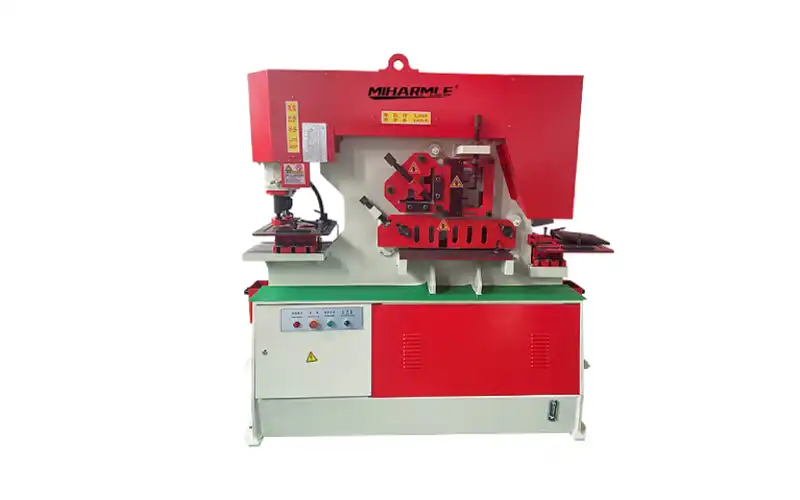
Metal fabrication operations require precision and uncompromised product quality. So, integration of V-grooving machines enhances efficiency, precision, and versatility. With these technologically advanced machines, manufacturers can achieve clean, sharp V-shaped grooves on the surface of various materials. V-grooving machines serve as essential tools in modern industrial manufacturing.
In this article, we will explore and analyze the various aspects of these machines in detail. We’ll discuss various types, components, working principles, and applications of V-grooving machines. Additionally, we’ll explore their advantages and limitations. Understanding the functionalities of these machines would be valuable for personnel working in the B2B manufacturing landscape. So, get started.
What is a V-Grooving Machine?

As the name suggests, the V-Grooving machine is specialized equipment that precisely cuts narrow V-shaped grooves into sheet metal. These grooves can vary in depth and width, and can be adjusted according to project requirements, which is crucial for bending processes. These metalworking machines are preferred for their high accuracy and repeatable results.
The standout point of these machines? They ensure clean, sharp edges and precise grooves without affecting the material integrity or finish. This means no burn marks or deformities can be seen on the sheet metal’s surface.
In metal fabrication, you know, minor errors matter. Here is where V-grooving machines deliver a level of precision unmatched by any other machining method. And that’s why they are used for various metalworking operations where precision and material appearance are the key. These include manufacturing specialized components and parts requiring meticulous detailing. The aerospace, interior design, elevator, and architectural industries use v-grooving machines as their core technology.
Types of V-Grooving Machines
V-grooving machines come in two main configurations, which are discussed below:
- Vertical V-Grooving Machines
A Vertical V-grooving machine is a type of machine that encompasses a vertical working table. It allows a slight back-and-forth or sideways feed. The blades in the machine move horizontally back and forth. At the same time, the plate moves forward and backward. This type is mainly used for creating diagonal grooves. Vertical machines are easy to operate as they feature a comparatively compact structure. Generally, they work well for smaller workpieces, such as woodwork or small parts. They offer higher precision and are often used when accuracy is critical.
- Horizontal V-Grooving Machines
These machines feature a horizontal working surface with a blade that moves forward and backward, as well as left and right. While here, the workpiece is clamped on the fixed plate. Horizontal V-grooving machines are best for larger, deeper grooves and can handle larger, heavier workpieces. These include long metal strips or large plates. They are stable and highly efficient. Horizontal machines usually have larger work surfaces and are suitable for mass production.
Here are the different types of v-grooving machines discussed below:
- Mechanical V- Groovers
Mechanical v-grooving machines use mechanical systems to operate. Key components of the system involve gears, belts, and motors. These machines are simple, durable, and operate manually. The settings, like groove depth and angle, are adjusted by the operator. Mechanical groovers are reliable and less expensive. But offer less precision and automation compared to CNC or hydraulic types. They are suitable for less complex grooving tasks.
- CNC V Groovers
One advanced V-grooving machine is the CNC (Computer Numerical Control) V-groover. They are equipped with computerized control systems that automatically control groove dimensions and movement. That’s why they offer unmatched high precision. CNC V-grooving machines are available in both horizontal and vertical configurations. They can easily create intricate, precise grooving patterns. As they support automation, various settings can be saved on the machine, reducing the need to set up from scratch each time. Additionally, they reduced the chance of operator errors. With so many features, CNC V-groovers are high-priced versions.
- Hydraulic V-Groovers
Hydraulic systems in these V-groovers drive the grooving blade. That’s why they offer high power and are suitable for heavy-duty tasks, handling thick materials effectively. Hydraulic v-grooving machines often combine CNC control with hydraulic power. So, you can easily create precise, intricate V-grooves. They feature gantry structures, alloy blades for durability, and advanced drive systems for accuracy. Hydraulic V-groovers operate efficiently for medium-volume jobs.
Working Principle of V-Grooving Machines
V-Grooving machines use a simple method to create intricate, precise grooves on the flat surface of sheet metal. They work on a basic working principle. So, here is the working process of these machines explained in a step-by-step guide:
- The grooving mechanism:
This core mechanism revolves around the cutting tool, or blade, which produces clean, sharp grooves on the workpiece’s surface. The cutting head moves along the material according to pre-set instructions by CNC control software or manual input methods. These include depth, angle, length, and other operational parameters.
- Material feed:
The material to be grooved—usually a metal sheet—is fed into the machine. It is securely clamped on the worktable. Depending on the machine’s design, either the material moves under a stationary tool or the cutting head moves over a fixed sheet. The feeding mechanism ensures smooth, continuous, and controlled movement of the sheet along the cutting path.
- Control system:
The control system uses advanced CNC controls or, in some cases, manual controls. According to the machine type you choose, the control system works to ensure the grooves created are very accurate and precise, as assisted. Advanced systems give the users more programmable and automation features.
Key Components of V-Grooving Machines
V-grooving machines consist of various components that make up the entire system. These components combine to form a system that ensures precise and efficient groove cutting on metal sheets. Each one serves a key role in the proper functioning of the machine.
- Frame and base
The frame and base form the machine’s foundational structure. Made of highly durable, strong materials such as Q345 steel or low-alloy, high-strength structural steel. This is important because the machine requires highly precise operations, where a solid base provides excellent rigidity, stability, and minimal deformation under heavy loads. These structures sometimes feature heavy-duty, multi-pass welded seam construction for added strength. All other components are fixed on the base of the v-grooving machine, making it the fundamental component.
- Clamping table
The clamping table or workbench serves as an important component for holding the workpiece. The clamping table may be fixed or slightly movable, depending on the V-groover configuration you choose. Additionally, it is adjustable. This means it can be adjusted to the length of the workpieces you’re working with.
- The grooving tool
The main component – the grooving tool serves as the core of the system. It comprises a sharp cutting blade installed on a tool holder. The main function of this component is to create intricate V-shaped grooves. The tool moves precisely to control groove depth, angle, and shape. The cutter’s movement is often driven to rotate or reciprocate, depending on the machine type. The grooving tool is designed to produce accurate, consistent depressions or recesses, which are essential in bending operations.
- Drive system
The driver system provides the power to move the grooving tool and produce accurate grooves. The system includes various components, including electrical and mechanical components. Plus a servo motor, pinion gears, and linear guide rails. This system is crucial as it offers adjustable speed and feed rates. This is essential when working with a range of materials and varying groove specifications. Additionally, it provides precise control of multi-axis motion (typically X, Y, and Z).
- Control and software
Basically, serving as the brain, the control system manages the basic to complex controls of the CNC V-grooving machines. The CNC controllers enable programming of different parameters. This includes grooving dimensions, cutting angles, sequences, and other operational parameters. You can save these settings and use them for future projects. This reduces the hassle of equipment setup and eliminates extra rework. At the same time, it works perfectly where consistency is crucial.
Applications of V-Grooving Machines
V-Grooving machines have broad applications across many industries due to their ability to create precise V-shaped grooves for easy bending and forming. They are commonly used in:
- Metal fabrication for preparing sheets for welding and bending.
- HVAC industry for duct and ventilation panel manufacturing.
- Architectural decoration, including façade systems, panels, and cladding.
- Elevator panel production and construction components.
- Cabinet and furniture making for sharp, clean folds.
- Automotive industry to produce interior trim, bodywork parts, and EV battery enclosures.
Advantages and Disadvantages of V-Grooving Machines
Advantages:
- Reduced bending radii: The V-shaped grooves produced by these machines are very precise. While the sharpness of the bends reduces the thickness at the bending line, it also reduces the bending radii and R-angle.
- Clean and consistent bends: The high precision in groove depth and angle results in clean bends, as assisted by the system.
- Reduce cracking and deformation: Grooving thins the high-strength material at the bend point. This means it reduces the risk of cracking and deformation at bends.
- Enhance aesthetic appeal: The grooving process stands out for accuracy without compromising material integrity. Instead, the clean lines enhance aesthetic appearance, making it look beautiful.
Limitations:
- Maintenance requirements: These machines must be regularly maintained to achieve high accuracy. This involves lubrication, repairing, and replacement.
- Material restrictions: Some materials are very challenging to work with. These include very thick or fragile metal sheets. They can either deform or crack during the grooving process.
- Safety regulations: Due to high-speed cutting and moving parts, strict safety measures and operator training are necessary. It will help prevent accidents, but it will increase operational complexity.
Conclusion
Now that you have all the information about V-grooving machines, you may know these machines stand out among other machines. They primarily function to create clean, sharp V-shaped grooves on the surface of a metal sheet. They are suitable for precision, accuracy, and unprecedented consistency, essential in bending operations. The V-shaped grooves make the metal thin at the bend. This reduces the bending radius and R-angle, giving it a metal surface aesthetically appealing look. V-grooving machines come in various types, including mechanical, hydraulic, and CNC versions. The CNC version offers advanced features that give its users more programming capabilities and automation. It makes them stand out for their high efficiency and suitability for bulk tasks. If you’re interested in these machines, make sure to buy them based on your business requirements.