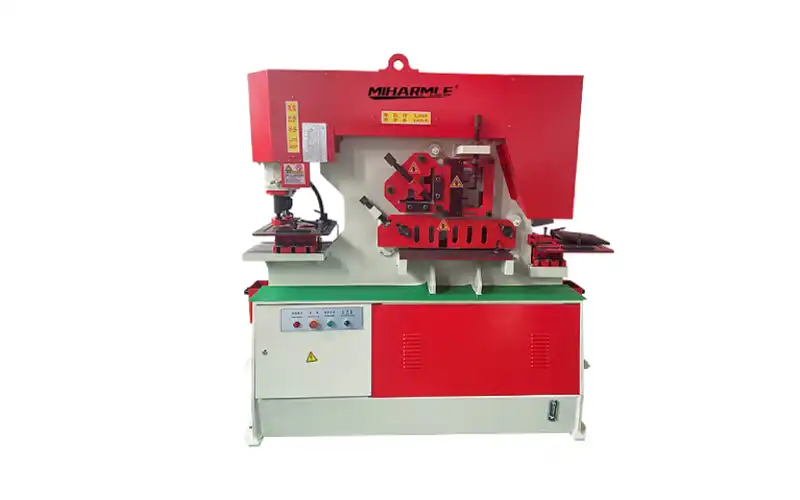
Introduction
The role and functionality of shearing machines are well-suited to the metal fabrication field. They serve as exceptional tools for cutting sheet metal by applying a high shearing force.
However, when it’s about choosing between two different types of shearing machines – mechanical vs. hydraulic – various factors determine the right choice, so what’s the better option? This decision may seem simple, but it will ultimately affect your productivity, the quality of the parts, and other factors.
Having valuable insights into these two strong contenders will help you make an informed decision. So, let’s dive in and explore these machines, including their basics, some advantages, and disadvantages. Additionally, we’ll conduct a comparative analysis to determine what each one offers.
How Mechanical Shearing Machines Work?
Mechanical shearing machines use a motor-driven mechanical power system. The main components of the system include a flywheel, shaft, gears, clutch/brakes, and a crank mechanism.
The electric motor spins the flywheel mounted on the shaft. The flywheel stores energy as rotational energy, allowing a lower-horsepower motor to be used. Then the clutch engages the flywheel, while the crank mechanism converts the stored rotational energy into linear motion. This mechanical energy is transmitted to the upper blade, which is connected to the ram. This leads the blade to move in a reciprocating motion. The controlled, rapid stroke of the upper blade past the lower fixed blade, shearing the metal sheet clamped in between the blades. As the cycle completes, the clutch and brakes reset for the next cut.
Mechanical Shearing Machines: Advantages and Disadvantages
Advantages
- Fast cycle speed. Good for repetitive cuts and high-throughput jobs.
- Simple drive train. Easier to learn, operate, and maintain than fluid systems.
- Lower upfront cost in many cases. Budget-friendly for small shops.
- Energy-friendly for short bursts. No hydraulic pump losses or cooling load.
- No hydraulic oil. Cleaner shop, no fluid leaks or disposal issues.
- Robust, shock-resistant frames. Handles impact loads well when within capacity.
Disadvantages
- Limited flexibility on thick or hard stock. Capacity drops as thickness and strength rise.
- Less precise force control. Cut quality can vary with material changes.
- Blade gap adjustments take time. Setting up changes slows production.
- Higher noise and impact. Not ideal for quiet or precision-focused cells.
- Not suited for continuous duty. Requires rest between heavy batches.
- More safety concerns versus modern hydraulic designs. Mechanics limits overload protection.
How Hydraulic Shearing Machines Work?
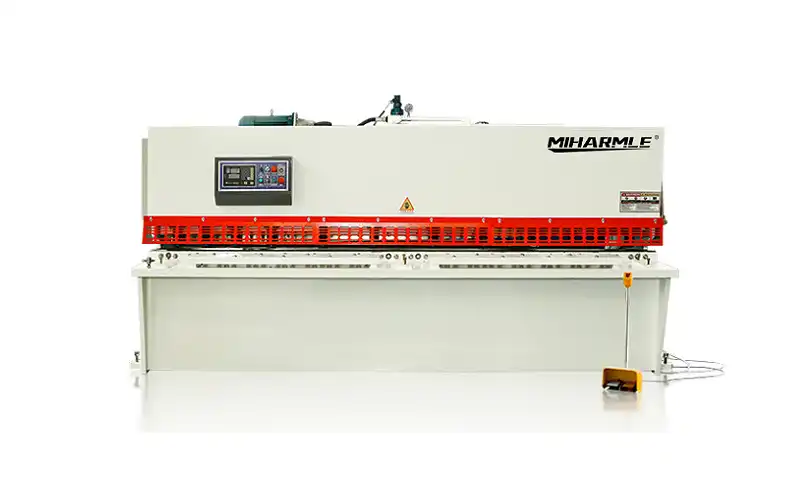
In hydraulic shearing machines, the system powers the hydraulic cylinders and a motor. Main components of these systems include a hydraulic piston pump, hydraulic hoses, valves, and a fluid reservoir.
The motor powers the hydraulic pump, which contains hydraulic fluid (oil). When the pump is pressurized, it pushes the hydraulic oil out through the hose. It then reaches the hydraulic piston cylinder, which is connected to the ram that drives the upper blades, forcing them downward. As with the mechanical shearing machine, the metal sheet is placed between the two upper and lower blades. The controlled motion of the moving upper blade and the fixed lower blade shears a metal sheet, producing clean cuts.
Hydraulic Shearing Machines: Advantages and Disadvantages

Advantages
- Strong, steady force. Cuts thick and hard metals with control.
- Smooth ram motion. Clean edges, less distortion.
- Adjustable settings. Easy to tune stroke, rake, and blade gap.
- Overload protection. Pressure relief prevents damage.
- Safer operation. Works with light curtains and safe stops.
- Consistent accuracy. Repeatable cuts across batches.
Disadvantages
- Higher upfront cost. Pricier than many mechanical models.
- More upkeep. Oil, seals, hoses, and filters need care.
- Higher energy at times. Pumps run and make heat.
- Oil quality matters. Dirt causes wear and faults.
- Slower in some jobs. Not as quick as flywheel drives.
- Training needed. Setup and troubleshooting are deeper.
Key Comparisons
Speed and Efficiency
Speed and efficiency are key factors that affect the production of any metal fabrication business. So, as mechanical shearing machines are concerned, their speed exceeds that of hydraulic versions. With a larger number of strokes per minute(about 60-100), they are known for their fast cutting speed.
While hydraulic shears are slower and less efficient, this is because they use hydraulic cylinders filled with hydraulic oil, which must be continuously regulated to produce power. The focus is steady motion and precision, not racing through the stroke. And they must be maintained even though not in use.
Precision and Reliability
So, hydraulic shears are more preferred for precision and reliability than mechanical ones. When working with mechanical shears, you may achieve precision in straight cuts and study cuts. But it loses accuracy at higher speeds and with thick, complex shapes.
On the other hand, hydraulic shearing machines may be less efficient but can cut complex, intricate shapes precisely. Their smooth and controlled motion supports tight tolerances of about 0.05mm on some machines.
Cutting Capacity
Mechanical shearing machines offer lower cutting force. That’s why these machines can handle soft and light metals. At the same time, hydraulic versions produce a larger force with hydraulic pumps. As a result, they can cut thicker metals and more rigid materials with ease.
Maintenance and Cost
The structure of mechanical shearing machines is simpler, while that of hydraulic systems is complex. And you know, simpler machines are easier to maintain than complex ones. This leads to mechanical shearing machines becoming more affordable. In contrast, hydraulic versions are priced higher.
Conclusion
Now, after a detailed analysis of mechanical vs. hydraulic shearing machines, you should have gained some helpful insights to inform your decision. To recall,
- Mechanical shearing machines benefit from their faster cycle times, low maintenance requirements, and lower initial cost. While they give you precision on thinner metal sheets, and lose accuracy for thicker material.
- On the other hand, we have hydraulic shearing machines. Though less efficient, but offers high force for shearing thicker and more rigid materials and handles intricate shapes easily. Their purchase price is a bit higher, but they require high maintenance.
So, when it comes to the decision, we recommend assessing your needs first. If you need a budget-friendly machine for high‑speed cutting of consistent stock, opt for a mechanical shear. And choose hydraulic shear for tighter tolerances, thicker or varying materials, and safer, controlled operation.
Just remember that the right deal closes with a reliable manufacturer!