
Introduction
In the metal fabrication industry, a plate-rolling machine featuring a 3-roll or 4-roll configuration plays a crucial role. They are used roll flat metal sheets into conical, elliptical, cylindrical, or even multi-radius profiles. Using a set of rollers, applying appropriate pressure, they perform precise rolling tasks.
Although various types exist, the most commonly discussed are the 3-roll and 4-roll.
Deciding between 3-roll and 4-roll machines can be critical. Each offering a set of benefits, the choice will ultimately impact your business’s precision, speed, and bottom line. So, engineers, tech professionals, and business owners must understand the core differences between the two variants.
In this guide, we will compare the 3-roll vs 4-roll machines. By breaking down the differences between the two, we’ll help you determine which configuration suits you best and make an informed decision.

Difference between 3-roll and 4-roll Plate Rolling Machines
Some people might think that the 3-roll and 4-roll types don’t make much difference. They think it’s merely a difference in the number of rollers. But adding a fourth roll changes the physics of bending, transforming the entire scenario. In fact, this single difference affects many factors from structural design to costs and beyond. So, a detailed comparison follows.
Shape and Structure
As the names suggest, the major difference is that the 3-roller uses 3 rollers, while the 4-roller uses 4.
- Shape and appearance
The 3-roll plate rolling machine features a simple yet sturdy design. It consists of a sturdy base, and the machine is made with premium pre-hardened steel.
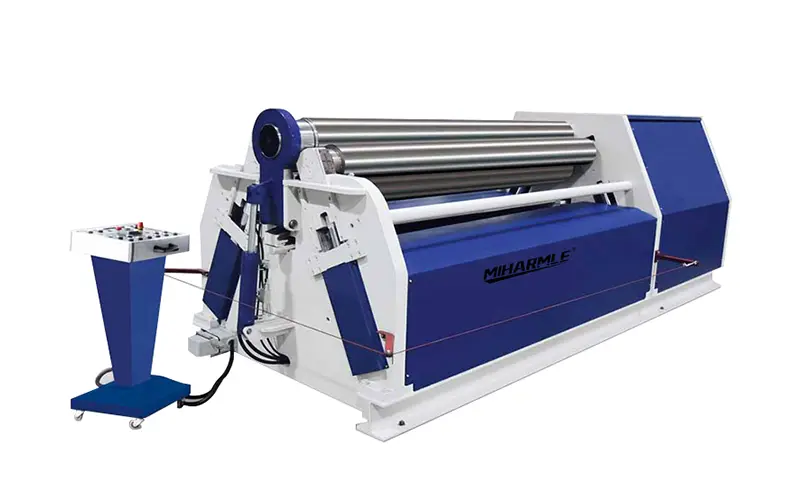
The 4-roll plate-rolling machine possesses a well-engineered compact body with smooth lines. It is usually hydraulic CNC operated, and every detail is precisely aligned with the sturdy exterior. The control panel is separate, featuring a simple, easy-to-use CNC LED display.
The appearance colors may vary depending on different manufacturers. Mostly, they come in blue and a darker shade of grey.
- Machine structure
The 3-roller consists of 3 rollers: 2 side rolls and one upper roll. The side rollers move back and forth. While the third top roll is fixed and rotates, it is adjustable. When the plate enters and exits, it is supported by the two side rolls, while the angle and position of the upper roller are adjusted according to the bending requirements. It applies a downward direction and bends the plate. In addition to rollers, the machine is equipped with other supporting components to ensure accuracy and consistent performance.
In addition to the three rollers, the 4-roller machine has an extra one. It includes two movable side rollers, one adjustable roller (drive), and one fixed top roller. This unique roller position effectively holds the plate firmly for mechanical transmission. Structurally, it integrates additional hydraulics and guidance mechanisms, including electronic balancing. This provides stability, ensuring precision and accuracy throughout the process.
Automation Level
With 3-roll machines, the operation is mostly simpler and more manual. This includes the basic push buttons, which are mainly seen on the control system. As the work requires manual input, the operator must be technically skilled. He must be experienced with the machine and able to make adjustments during operation. Higher automation or (NC/PLC) is less common, but you may see semi-automatic and fully automatic 3-roll plate rolling machines. They are suitable for high-volume tasks and deliver high accuracy.
With a 4-roll machine, you get integration of the CNC system with a touchscreen panel, which simplifies control and programming. Other features may include data editing and storing, an electronic balancing system, an automatic sequencing system, and fault self-diagnosis. These features and systems assist in consistent tasks and accuracy. In addition, the self-diagnosis system speeds up the bending process. The overload system stops the machine when any fault is detected. A higher level of automation allows for work with little human involvement.
Precision
Although the 3‑roll machines are precise, they tend to leave a longer flat end. This may require additional operations or equipment to correct them. This level of precision is suitable for low to medium production volume.
In 4-roll machines, a higher degree of precision is observed. The four rolls prevent the formation of straight edges and improve roundness. They can even process cones and other spherical workpieces accurately. The close positioning, four-roll movement, and force distribution provide uniform pressure. This leads to better straightness and consistent diameters throughout the shell. Higher precision matters across a range of industrial tasks in various sectors. So these machines are used for repeatable tasks and for manufacturing parts that require tight tolerances. These include sectors such as infrastructure, defence, and machinery parts.
Production Efficiency

The production efficiency of 3-roll plate rolling machines is relatively low. This is due to various factors involved. Major ones include manual operations and limited automation. When the bending process requires manual input, cycle time increases. It results in overall low throughput and is more sensitive to operator speed and skill.
For 4-roll plate-rolling machines that incorporate various automated features and a CNC-programmed system, production efficiency is much higher. In addition, the 4-roll machine can clamp, pre‑bend both ends, and roll the full cylinder in a single setup. This is done without flipping the plate, which doubles the speed, production efficiency and capacity. They are most preferred at an industrial level due to their fast production, short cycle times, and reduced rework and scrap.
Application Differences
The 3-roll machines are a bit slow and mostly mechanical, while being simple and easy to use. So, they are generally suited to low to medium quantities and production loads. These mainly include job shops or small businesses with minimal investment. Many heavy‑duty 3‑roll machines can handle very thick plates and large diameters. This makes them suitable for heavy vessel shells, large pipes, and custom one‑off jobs. Application sectors may include construction, small metal products and metal processing.
4-Roll machines are best for large-scale industries. These include manufacturing, automobile, precision machinery and others. These industries require higher dimensional accuracy, repeatability, and the ability to work with tight tolerances. And that’s where 4-roller machines stand out. The work is exceptional for high precision processing and perfect cylinders.
Cost
It is clear that the cost of the 3-roller machine is much lower than that of the 4-roller machine. This is because the 3-roll plate-rolling machine offers a simple yet practical layout with limited features. There are various models of these machines available at affordable prices. If your business involves small-plate rolling tasks or is mostly used for prototypes where high accuracy isn’t needed, go for 3–roller machines. In compact environments, they perform well, and you don’t have to spend much.
4 roller machines, on the other hand, are packed with features offering exceptional accuracy. They include additional roll, hydraulic systems, automation hardware, and CNC/NC controls. And that’s why they are priced higher. The initial higher investments can benefit in the longer term when used for bulk production. Additionally, you can save on excessive labor costs by doubling your productivity.
Maintenance
With fewer mechanical or hydraulic parts, the 3-roller machine’s maintenance is much easier and cheaper. These machines have limited-wear items such as bearings, seals, and drive components. This means they may only need routine maintenance. At the same time, the troubleshooting tends to be more straightforward. No highly professional technician is needed for such services.
While a 4-roller machine, you may know, encompasses various hydraulic circuits, sensors, encoders, and CNC hardware. Such complex sensors require knowledgeable higher-level diagnostics and sometimes OEM service support. And this results in high maintenance costs.
Some other differences
| Aspect | 3‑roll plate rolling machine | 4‑roll plate rolling machine |
| Plate thickness focus | Often strong in very thick, heavy plates. | Strong across thin to medium‑thick plates; also available in heavy-duty. |
| Batch size | Prototypes, small batches, varied jobs. | Medium to large batches, repeated parts. |
| Shape flexibility | Cylinders, cones; more manual control over shape. | Cylinders, cones and complex transitions with higher reproducibility. |
| Operator skill requirement | Higher; results depend strongly on experience. | Lower; more guided, and automated operation. |
Conclusion
To conclude, after a detailed comparison of 3-roll vs 4-roll plate-rolling machines, both may appear similar at first. But the addition of an extra roll and various features makes the 4-roller machine highly automated and different from the 3-roller mechanical machine. 3‑roll plate rolling machines are structurally simpler and more affordable. They are suitable, simple, and low-volume jobs that require skilled operators for manual input. Whereas 4‑roll machines add an extra forming roll, incorporate CNC software, and include other automated features. These machines require minimal to no manpower and excel at highly precise jobs. They are best suited to industries where accuracy is key.
With that in mind, it is always important to assess your needs and select the machine accordingly. This will save you from making an uninformed decision. Additionally, choose a reliable manufacturer that provides premium quality with after-sales support.